Wake Forest Athletics
Caldwell Counting on Experience from 27 Seniors
8/25/1999 12:00:00 AM | Football
Aug. 25, 1999
By Sam Walker
Head coach Jim Caldwell knows the bottom line of NCAA Division I football is winning. He will tell you the 1999 version of the Demon Deacons, who stumbled to an injury-riddled 3-8 mark in 1998, have a very good chance to prove they can win with 27 seniors scattered among 49 returning lettermen.
The Deacons were riding a wave of enthusiasm entering last season, boasting the most experienced squad in Caldwell's tenure and a pre-season ranking of No. 22 in Sports Illustrated's pre-season issue. However, the Deacs were throttled 42-0 in their season opener at Air Force and lost their final five games. Wake won three of their next four games following the loss at Air Force but was decimated by numerous injuries that left a skeleton crew of young players to finish the season. Wake lost two October games by a total of six points in the final minute and finished the season playing ACC powers Virginia, N.C. State, Florida State and Georgia Tech.
Caldwell has compiled a 17-49 record in six seasons and wants his seventh to produce his first team over .500. "There's nobody that wants to win more than I do," Caldwell said. "There's not a player, there's not a coach, there's not an administrator who puts as much time into this business as I do. Nobody wants to win more than me. That's one of the reasons I decided to have a little more of a role in our offense. I'm going to step right in the middle of it and make certain our team gets a sense of how important it is to be productive and win football games."
One of Caldwell's trademarks is the redshirting program he immediately initiated when he arrived at Wake Forest in 1993. Sixty-six of 70 players (redshirt freshmen through seniors) have experienced one redshirt year. Caldwell believes in allowing his recruits to adjust to college life and mature both mentally and physically. Twenty-four of 27 seniors on this season's squad were redshirted. "I think this year you'll be able to see the effects of our redshirting program," Caldwell said. "We have a large group of seniors, and a large majority of them have been redshirted. Without a question they're stronger and have increased in terms of size, but also the maturity factor has helped us in terms of foot speed."
Speed is something Wake Forest will have all over the field this year. Last spring the Deacons 4x100 meter relay ACC champion track team was comprised of four athletes who play football. Chris Justice, Reggie Austin, Jammie Deese and John Stone each have exceptional speed. Stone went on to win the 100-meter dash with Austin finishing second. However, Caldwell maintains that several other football players who do not compete with the Wake track team aren't far behind in terms of speed. But neither seniority nor speed necessarily translate into a winning record or possible bowl bid, something which Caldwell's teams have hungered for the past three seasons. Wake's three victories in the four games following the Air Force debacle gave hints that the Deacons might have turned the corner if injuries had not forced personnel and strategic changes. But Caldwell is never satisfied, and the Demon Deacons must prove themselves worthy.
"We've made some adjustments with our offense, and we'll be a different looking team than we've been in the past," Caldwell said. "We have a change in the quarterback position and the flavor of our offense will change because we'll run the ball more than in previous years. It's going to be the toughest season for us because our schedule is tougher. We're away for the first couple of ballgames, and we have some tough teams that we're going to be playing." Wake Forest worked primarily on the running game last spring and for good reason. By compiling over 5,000 yards passing over the last two seasons, the Deacs are proven through the air.
With just over 1,880 yards rushing over the past two seasons, Wake Forest is far from satisfactory on the ground. Last season the Deacons rushed for just 719 yards with Morgan Kane, their leading rusher, accumulating 454 yards behind what may have been the biggest offensive line in the ACC. Those numbers show up red on Caldwell's 1998 statistics sheet and prompted him to move out Hank Small, the offensive coordinator, in the offseason and assume more responsibility for the offense.
"We've got to be able to control the line of scrimmage," Caldwell said. "In most cases I believe running the football is an attitude. Certainly it has talent connected with it, but I think it's an attitude as well. We have to commit ourselves to run the ball. Teams that have thrown the ball as much as we've thrown it have a tendency to lean upon it too much and in some cases when we can control the game we wind up presenting ourselves with more turnover opportunities. We'll try to reduce our turnovers by running the ball."
If there is a silver lining to 1998's dark cloud, Caldwell will point toward the depth that was built last season due to necessity. Those who were thrown into the heat of battle last year are now battle-tested, and those who are returning will have to compete even harder to regain their starting positions. From a coaching standpoint, Caldwell feels his staff has a clear understanding of personnel and their capabilities. "Experience makes a huge difference in terms of preparation and adjustments made during game day," Caldwell said. "When you have an older group often times they set the tone for the rest of your team in terms of work habits and practice habits. If I gauged by what they've done on their own this summer I would say they have set a tremendous standard. We have a large group of willing upperclassmen. "We had a number of injuries last year and when we began the season we didn't anticipate playing some of our younger players as much as we did. In some positions we really feel that we are battle-tested, particularly with our linebacking corp.
"This year going in we have guys like Marquis Hopkins and Nick Bender, Ed Kargbookorogie, and Abdul Guice who have been battle-tested so we have some experience there. We're still not where we need to be, but we have a pretty good nucleus with Kelvin Moses and Dustin Lyman coming back. The same thing happened with the interior of our defensive line with Kelvin Shackleford and Da'Vaughn Mellerson being injured. Now we have them back plus some guys who have an opportunity to play a lot more football than they would have, i.e. Nate Bolling and some others."
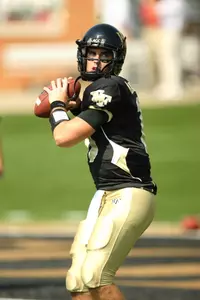
The Deacons have some known entities but an infusion of youth could also aid in the building of team chemistry. Nationally-ranked recruit C.J. Leak became Caldwell's finest "catch," and Caldwell has stated that Leak will play some this season. But Caldwell is adamant that senior Ben Sankey is his top quarterback entering fall practice. Dan Bradley and James MacPherson also have more experience than Leak, who must learn the Wake offense and adjust to the speed of the game. "Ben's been in several games and he's an older guy who is smart, has good leadership skills, and he adds a different dimension to our offense. Ben's our starter right now, but it's going to be a competitive pre-season. He's paid his dues and he's capable. He's big and he can run."
A veteran defense will be led by seniors Dustin Lyman, who should be fully recovered from a torn ACL, and Kelvin Moses, who was granted a sixth season of eligibility after sustaining a knee injury in August 1998. Virtually the same defense that ranked 10th nationally in defending the run in 1997 will be on the field in 1999. There are many reasons the Demon Deacons anticipate a successful season, but the excitement is reserved because 1998 proved to be a lesson in just how fragile a football team can be. Barring any major injuries, Wake Forest may provide some excitement and play a role in the conference race. Caldwell just plans to keep it simple. "It's important to our football team to do well," Caldwell said. "We will focus on the things we can control, and we have a committed group."