Wake Forest Athletics
From the Beginning to Now: Wake Forest Men’s Soccer’s Bond Brings Special Culture
10/28/2020 3:34:00 PM | Men's Soccer, Les Johns
From humble beginnings to sustained national success, Wake Forest men’s soccer has experienced significant growth the last 40 years, but one thing remains the same: the family-like culture.
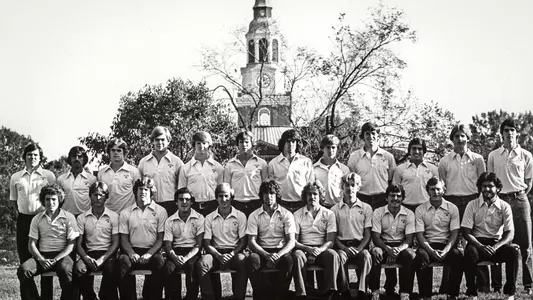
As part of the class that started the Wake Forest men's soccer program 40 years ago this fall, Mark Erwin helped clear rocks from the playing field days before each home contest as they built the Demon Deacons' culture from the ground up, starting with coach George Kennedy.
Years later, during his prolific 26-year career in the United States Army that culminated with a term as Chief of Staff of the United States Army Special Operations Command, Erwin was set to go out for operations in Iraq — just as the Deacs were squaring off against Ohio State in the 2007 National Championship game.
He couldn't find a televised broadcast, or even a radio call, but was able to find a site with regular scoring updates. Before leaving for six hours of operations in a hostile land, Erwin knew the Deacs were trailing 1-0.
Second half goals by Marcus Tracy and Zach Schilawski, though, gave Wake Forest an incredible come-from-behind win over the Buckeyes to claim the national title, much to Erwin's delight.
"I came back and went straight to my computer," Erwin said. "I saw where we'd won 2-1 and it was just a huge freaking deal for me. I was all by myself, and nobody around me knew anything about Wake Forest Soccer.
"But for me, it was just one of the highlights of my military career that I can still remember clearly today."

The joyous locker room in Cary, N.C., was shared with many alumni.
"When they won the national championship, I was in the locker room for that," said Craig Conger (1988-91). "It was incredible that I and other alumni had a chance to have access. I was so happy for the program and the younger players."
Whether in St. Louis, Houston or Cary, there's always a large group of alumni who travel to cheer on the Deacs when they advance to the College Cup.
"We'll have 50-60 alumni show up for Final Fours," Conger said.

"I don't know how other soccer coaches interact with their alumni, but I can't imagine another coach being more interactive and more supportive of alumni soccer players than Bobby [Muuss]," Todd Renner (1986-90) said. "He's been great. I traveled to Houston to watch the Deacs in the Final Four, and of course made the short trip to Cary."
The culture developed and nurtured through four coaching staffs has led to unparalleled success on the pitch — 273 wins entering this season, eight ACC Regular Season Titles, three ACC Tournament Championships, 23 NCAA Tournament appearances, six College Cups and the 2007 National Championship.
"People used to say that Wake couldn't win the big game, and then we won the national championship," said Lyle Adams (2005-08).
"The sum is greater than the parts. It's not one aspect that makes Wake Forest soccer culture great, it's everything around it — the support staff, the players, the coaching staff, the campus environment and the surrounding community. Being a Wake Forest soccer player is an honor. You're well respected in the area and everybody knows that."

But beyond the on-the-field success, it's a culture that has developed ties that bind different eras together in a team spirit that leads to continued involvement. The alumni stay connected with each other, with the program and network among themselves despite living through what had to be vastly disparate circumstances during their Wake Forest experiences.
They give back to the program and give to each other.
"They always preach family," said Anthony Arena (2009-12) of his time at Wake Forest. "It wasn't just the soccer team, it was everywhere on that campus. It's small and tight-knit. You don't realize it until you step back and think about the relationships you've formed with people 20 years before you. It's just understood. We take a lot of pride in it."
"The program as a whole is special. It takes guys a different amount of time to understand that. Sometimes it takes a couple years after graduation to step back and realize that. But it's a family. It's a special place to go to school and an even more special place to play soccer. If you are fortunate enough to go on and play soccer professionally, the amount of times where you played college gets brought up in the locker room more often than you would believe. It's nice to have those bragging rights wherever you go. To say you played at Wake Forest holds a lot of weight."
The Deacs went 12-9-1 in 1980, the first of six seasons under Kennedy, who finished with a 62-55-12 record as head coach. Stef Hamilton arrived in 1981 and was part of the fledgling program.
"It changes your life," Hamilton said. "We came from low-to-no means. My mother told me that we didn't have money for college, so I'd better do something. I had to figure it out and use my talent. We started training and working harder. Luckily, George Kennedy was good enough to come down and visit to see us play.
"Obviously I got to Wake Forest and it was a comfortable fit. We were the pioneers. I was in the second recruiting class. We really started putting together a cool program. We started getting stronger and the players started coming in. My four years were fantastic. We had bad seasons and good seasons, but we had a great time."
Walt Chyzowych took the program to the next level during his tenure, earning an NCAA Tournament bid in 1988 and making an appearance four-straight seasons.

"Walt came in and he had a plan," said John Joseph (1984-87). "He put us at ease right away. This is the way it's going to be. Everybody starts from scratch. Then he hired Jay [Vidovich], who fit in. Jay was the guy who jumped in scrimmages with us, got in the training sessions and talked with us a lot.
"Walt intimidated a lot of the guys, because of the figure he was in soccer. He was a great guy, but when he first got there he could be a little intimidating. Jay was that buffer early on. I thought he did a great job and was the guy that kept everything going during that transition."
The transformation from bottom-dwelling newcomer to contender was rapid.
"I don't want to diminish any of the wins that took place before we got there, but I don't think any of us thought, given how competitive the conference was, that in four years we would go from the bottom to winning the ACC Tournament and being a top-five team," said Todd Renner (1986-89). "If you work hard, sometimes you surprise yourself. We all had confidence, but when you haven't put it all together at that level. First you win a couple of games and shoot into the top-20. Then you beat a ranked team. Then you get into the top-10. Then you win the ACC and make the top-five.
"It was a great journey. If we were honest, we would say we exceeded our expectations, and that was a lot of fun."
Conger was on the team that advanced to NCAA Tournament play all four years of his eligibility.
"We were in the national rankings and made two ACC finals," he said. "That was a big move for the program. It felt incredible. I wasn't too aware of Wake Forest beforehand, but knew of Walt and Jay. I turned down North Carolina, which had a historic program, to come here. It's kind of cool to see the big jump where Wake got on the map. Other teams became afraid to play us, because we were mentally strong and physical. We might not have been that threatening in previous years.
"I'm immensely proud. To be a part of this program just makes you very proud to say you played a small part of this program. It's incredible."
Vidovich, who accumulated a 254-103-48 record in 19 seasons at the helm, took the Demon Deacons to the College Cup for the first time in 2006.
"That group that was here between 2001 and 2005 really changed the culture of the program in a positive way," said Amir Lowrey (2001-04). "I think each class shifted it more and more positively. One thing I'm proud of is carrying that torch forward and helping to set the bar forward for the next group of Demon Deacons in the Wake Forest soccer program.
"I am proud of the bonds we built as teammates with each other and with the university, as well as the entire Wake Forest soccer community."

The Deacs have now reached the College Cup six times, all within the last 13 seasons. Since the hire of Muuss as head coach in 2015, Wake Forest leads the country with 94 victories, leading second-place Indiana with 78.
"Jay is arguably one of the best college coaches of all-time, when you look at what was built," Joseph said. "And Bobby was on Jay's staff and was able to fit right in and continue what was built. It's been a great run over the last 25 years."
It's clear that although specific experiences have varied through 40 years of Demon Deacon soccer, some things are similar for current, past and future players. They get challenged at Wake Forest like never before, they will experience a tight-knit family culture both on the team and within the university as a whole, and the rewards are overwhelming.
"The size of the school and the academic rigor does add to the mystique," Renner said. "It gives you that feeling that you've made it. You not only achieved on the pitch, but you also made it to graduation. There's nowhere to hide at Wake Forest academically. It's not a big school. It's a liberal arts college. You're going to have to take a foreign language. You would be hard pressed to walk out of Wake and think you snuck through the system. The smaller school does create more of a lasting community."
There's nothing in his life that has replicated the experience at Wake Forest, Lowery says.
"The core values of the program, the family atmosphere that's infused in the team the moment you get there — those are the elements that really stick out," Lowery continued. "That's what makes that bond strong. When you get to campus, start training and get into the flow at Wake Forest, you understand you're a part of something different.
"None of us have left Wake Forest and experienced a similar unit. Nothing mirrors the family environment and the real commitment to the team. It just can't be replicated anywhere else."
There's intense pride that comes with having worn a Wake Forest soccer jersey, Arena said.
"Day in and day out, you have to earn it, so that's something you take a lot of pride in as a player," he said. "Once I graduated and went on, you realize what a special place Wake Forest is, not just as a soccer program.
"Obviously the soccer program has a unique bond with our alumni, but the university as a whole, the people you meet and the opportunities that come are just endless."

The game of soccer in America has evolved in the last 40 years, but so has the Wake Forest culture, Joseph said.
"We've all been through the same thing, but with different circumstances," Joseph said about the bond between Wake Forest players from different generations. "You've seen an evolution in coaching through the years. The game has evolved and the players have evolved. It was a different way to play when we were there. Wake has been fortunate, with the talent we've been able to get."
The bond at Wake Forest seems unique, according to Conger.
"Some of my best friends went to other programs, and when they find out what we have at Wake Forest, they are utterly shocked and jealous," he said. "They don't see that sort of family-focused program where they are from. There are Wake Forest soccer players 10-to-20 years younger than me who I know personally. I can reach out to them via social media, or we see each other at a get together or to watch the College Cup. That's not the case at probably 99.5 percent of the colleges out there.
"It's about being welcoming and being like family. Coming to Wake Forest was the best decision I ever made. It changed my life, to be honest."
Having watched Wake Forest soccer develop from the early days to become among the top programs in the country, Erwin wants to help ensure the Demon Deacons stay at the top of the heap.
"I'm just proud to be a part of the start of something that's turned out to be so incredible," Erwin said. "It has never left my mind of how important Wake Forest Soccer is to how I've turned out in my life. I owe tons to Wake Forest and specifically the soccer program, which is why I want to give back."