Wake Forest Athletics
Gold Rush: A Season To Remember...Again and Again
2/16/2020 6:14:00 PM | Men's Basketball, Gold Rush
This story was originally published in the February 2020 issue of Gold Rush.
There are Good seasons when teams achieve at a high level.
There are Great seasons when championships are won, even in national competition.
Then there are Magical seasons, ones that live on because of their dramatic moments, remarkable accomplishments and lasting impact. These are seasons that players, coaches and, of course, fans, treasure for a lifetime for how they evolved and what they meant – not just at that time but for seasons and more seasons to come.
Twenty-five years ago, there was one such Magical season for Wake Forest Basketball.
The opening of Lawrence Joel Coliseum five years before had signaled a new era at Wake Forest. The arrival of Rodney Rogers one year later and his dynamic play, supported by a highly capable cast, had served to legitimize Demon Deacon Basketball nationally over three seasons.
However, there was always North Carolina. There was always Duke. And the rest of the nine-school ACC of that era annually included three or four teams in addition to the Tar Heels and Blue Devils who would be nationally ranked or featured All-America performers.
Wake Forest had finished third (or tied for third) in the conference in three of the previous four years, including 1994, and had made four straight NCAA Tournament appearances. Three seniors instrumental to the '94 team's success – Marc Blucas, Charlie Harrison and Trelonnie Owens – had departed, though. The Deacs under sixth-year head coach Dave Odom were picked to finish third again as the 1994-95 schedule began.
"I felt like we would have a good team, even a better team than 1994," Odom recalls. "We had approached building the program (in previous seasons) by first attacking the teams who traditionally were in the middle of the pack. We had to get past them first before we could get to the top. And the record shows we had done that.
"As heart-breaking as the loss to North Carolina was the year before (Wake had led by three points with 11 seconds left in the ACC Tournament semifinals but lost 86-84 in overtime), something about (that game) told me we belonged. And in my quietest moments immediately after, I felt if we had a good offseason, preseason and stayed healthy, we could play with the best in the ACC."
Odom's roster included only two seniors – athletic forward Travis "Scooter" Banks, who had started just five games as a junior, and team leader Randolph Childress, a first-team All-ACC selection the year before.
Childress was joined as a returning starter by sophomore Tim Duncan, whose abilities the basketball world was just beginning to recognize and appreciate.
Rusty LaRue, who doubled as Wake Forest's starting quarterback, also returned as a key backcourt player, but the remainder of the primary parts to this team would be newcomers.
Forward Ricky Peral had practiced with the squad the previous season and was now eligible. He was joined by four freshmen who made up a solid but relatively unheralded class.
"I was optimistic," Childress says in looking back at the onset of his final campaign as a Wake Forest player. "We knew Tim was going to be good, but we had lost some real 'glue" guys so there was some uncertainty, too."
That uncertainty continued throughout the non-league schedule, although the record might indicate otherwise. A couple of wins were followed by a double-figure loss to Florida, which had four starters returning from a Final Four club, and Childress said afterward, "Until we get five guys with some chemistry, we are going to struggle."
The Deacon star, now in his eighth season on the Wake coaching staff, also recalls one early game when Odom asked him to tone down his aggressive scoring approach to see how Duncan would respond as the primary figure in the team's offense. After the young post player scored 20-plus points while adding his customary double-figure rebounds, Odom told Childress privately, "I think we found out what we needed to know."
Odom says it wasn't just his future All-American center who he was watching closely during that season's first few weeks.
"We needed some time to get acclimated to each other, to what we wanted guys to do," Odom, who would earn his third ACC Coach of the Year award three months later, remembers.
"There were the two key pieces – Randolph and Tim – whose seriousness of purpose every day in practice as well as in the games was unquestioned. Rusty was a great shooter and had a tremendous basketball IQ, but he was coming off football.
"Scooter Banks, who is probably the best post defender I ever coached, was just emerging. Ricky Peral was new, and then we settled on Jerry Braswell and Tony Rutland as a backcourt tandem alongside Randolph. They were freshmen who brought the team levity along with ability, but had to learn their roles on the court as well."
Wake Forest won seven of eight early contests, then the ACC season began as most Deacon doubters would have forecast. Home wins over Florida State and #11 Duke were followed by road defeats at #9 Maryland and #22 Georgia Tech.
Two more victories, including a 71-70 thriller at #15 Virginia preceded what would be the first of what those who know point to as two key points in the season – and both came in defeat.
Joel Coliseum was never more alive than when #3 North Carolina visited #15 Wake Forest on the last Saturday in January. The Deacons twice led by 10 points in the second half and held a 61-57 advantage with 26 seconds remaining before a Tar Heel three-point play, a failed inbounds attempt by the Deacs and a Donald Williams jumper in the final seconds spelled a gut-wrenching loss.
Odom, though, refused to let the bitter outcome detract from what he saw developing.
"That loss, in my mind, turned that season as much as any game," he thinks back. "For more than 39 minutes, we knew we were the better team."
Wake Forest went on to win three straight outings before suffering another difficult defeat when a Childress three-pointer bounced off the front rim as time expired in a 69-67 loss at Florida State. What transpired afterward, however, made the real difference according to the fearless point guard.
Freshman Tony Rutland had found out earlier that day that that his mother had passed away after battling cancer. The rookie guard played the game with that burden.
A locker room already somber because of the loss became a team bonding experience, Childress recalls, as the Deacons wept together in mourning Rutland's loss.
"At that moment, basketball wasn't as important anymore," Childress says. "I remember that we all just sat and cried. We talked about things that brought us together as a team. There's no question in my mind that was the turning point in our season."
Odom agrees.
"Whatever small gap there was keeping that team from being totally together, to being totally committed to winning and to each other, that was erased that day," he says.
Three days later, Childress again took the final Wake shot at Duke. This time he connected for a 62-61 victory that was the first of seven consecutive wins that led to the Deacons ascending into the Top Ten. The streak included wins over #7 Maryland, #18 Georgia Tech and a spectacular 79-70 payback victory over #2 North Carolina when Childress and Duncan combined for 51 points to lead Wake Forest to its first win in Chapel Hill since 1982.
More importantly, the Deacons finished in a four-way tie for first place in the ACC regular season and were the top seed heading into the ACC Tournament in Greensboro – and three days that no Demon Deacon fan at that time will ever forget.
First came a noon matchup with a talented Duke team that had struggled without head coach Mike Krzyzewski, who had undergone back surgery prior to the season. Shockingly, the Blue Devils held a 31-13 lead midway in the first half, at which point Childress, after vocally (some might say profanely) taking over a Wake Forest huddle during a timeout, ignited his team by scoring 27 first-half points (he finished with 40) to spark a 35-point turnaround and an 87-70 win.
The next day, Wake Forest trailed Virginia at halftime, 36-28, but stormed back behind Childress (30 points) and a strong defensive effort for a 77-68 triumph and a spot in the Tournament finals for the first time since 1978.
The true magic in this Magical season then came to pass on ACC Championship Sunday.
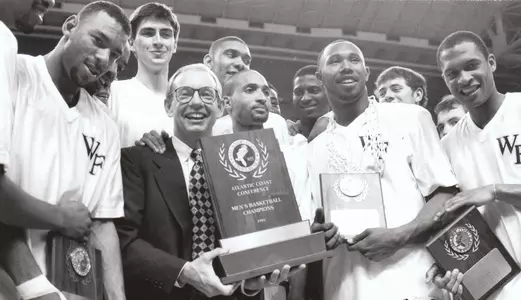
All Wake Forest followers know what happened. A Childress jumper with four seconds left in overtime resulted in an 82-80 Deacon win over North Carolina and the program's first ACC title since 1962. The basket gave Childress 37 points in the game and a tournament record 107 points over a storybook 72 hours.
Dan Collins, the longtime beat writer covering Wake Forest for the Winston-Salem Journal, so skillfully wrote afterward:
"Randolph Childress, with one flick of his wrist, wiped out 33 years of frustration, a 38-year-old tournament record and a long-standing perception that while the Deacons could play giant-killers, they could never be the giant."
Odom remembers as the final horn sounded and the court was flooded by media, he quietly took a seat on the team bench and began scanning the stands.
"I wanted to find (wife) Lynn. I remember wanting to see my mother, too, but that was impossible because she had passed away. But when I finally made eye contact with Lynn, I was overcome by thinking how much had gone into this moment and the sacrifices that had been made by so many."
The Wake Forest campus became a bedlam of celebration far into the evening. Childress returned there after the game with his family and recalls that he couldn't drive onto the grounds because of all the traffic.
With a then-school-record 24 wins, a ranking of third in the country and the school's first (and still only) #1 seed in the NCAA Tournament, the Deacons went on to defeat North Carolina A&T and Saint Louis in their first two NCAA outings, but dropped a hard-fought contest to Oklahoma State in the Sweet Sixteen.
Whether it was an illness that struck Childress during the NCAAs or the residual effect of that season-ending 10-game winning streak culminated by the memorable three days in Greensboro, no one knows for sure or actually cares very much. A long season that had begun with the same marginally optimistic expectations had become one that will forever hold a cherished place in Wake Forest lore.
"People remind me now and then of moments from that year," Childress says, "especially the ACC Tournament, of course. But they don't know about the journey we took to get there.
"There were no egos on that team. Everyone did their part. It was a different group."
A special group. A Magical group.
There are Good seasons when teams achieve at a high level.
There are Great seasons when championships are won, even in national competition.
Then there are Magical seasons, ones that live on because of their dramatic moments, remarkable accomplishments and lasting impact. These are seasons that players, coaches and, of course, fans, treasure for a lifetime for how they evolved and what they meant – not just at that time but for seasons and more seasons to come.
Twenty-five years ago, there was one such Magical season for Wake Forest Basketball.
***********************************************
The 1994-95 basketball season began with positive but restrained expectations for the Demon Deacons, which was not unusual or surprising. The opening of Lawrence Joel Coliseum five years before had signaled a new era at Wake Forest. The arrival of Rodney Rogers one year later and his dynamic play, supported by a highly capable cast, had served to legitimize Demon Deacon Basketball nationally over three seasons.
However, there was always North Carolina. There was always Duke. And the rest of the nine-school ACC of that era annually included three or four teams in addition to the Tar Heels and Blue Devils who would be nationally ranked or featured All-America performers.
Wake Forest had finished third (or tied for third) in the conference in three of the previous four years, including 1994, and had made four straight NCAA Tournament appearances. Three seniors instrumental to the '94 team's success – Marc Blucas, Charlie Harrison and Trelonnie Owens – had departed, though. The Deacs under sixth-year head coach Dave Odom were picked to finish third again as the 1994-95 schedule began.
"I felt like we would have a good team, even a better team than 1994," Odom recalls. "We had approached building the program (in previous seasons) by first attacking the teams who traditionally were in the middle of the pack. We had to get past them first before we could get to the top. And the record shows we had done that.
"As heart-breaking as the loss to North Carolina was the year before (Wake had led by three points with 11 seconds left in the ACC Tournament semifinals but lost 86-84 in overtime), something about (that game) told me we belonged. And in my quietest moments immediately after, I felt if we had a good offseason, preseason and stayed healthy, we could play with the best in the ACC."
Odom's roster included only two seniors – athletic forward Travis "Scooter" Banks, who had started just five games as a junior, and team leader Randolph Childress, a first-team All-ACC selection the year before.
Childress was joined as a returning starter by sophomore Tim Duncan, whose abilities the basketball world was just beginning to recognize and appreciate.
Rusty LaRue, who doubled as Wake Forest's starting quarterback, also returned as a key backcourt player, but the remainder of the primary parts to this team would be newcomers.
Forward Ricky Peral had practiced with the squad the previous season and was now eligible. He was joined by four freshmen who made up a solid but relatively unheralded class.
"I was optimistic," Childress says in looking back at the onset of his final campaign as a Wake Forest player. "We knew Tim was going to be good, but we had lost some real 'glue" guys so there was some uncertainty, too."
That uncertainty continued throughout the non-league schedule, although the record might indicate otherwise. A couple of wins were followed by a double-figure loss to Florida, which had four starters returning from a Final Four club, and Childress said afterward, "Until we get five guys with some chemistry, we are going to struggle."
The Deacon star, now in his eighth season on the Wake coaching staff, also recalls one early game when Odom asked him to tone down his aggressive scoring approach to see how Duncan would respond as the primary figure in the team's offense. After the young post player scored 20-plus points while adding his customary double-figure rebounds, Odom told Childress privately, "I think we found out what we needed to know."
Odom says it wasn't just his future All-American center who he was watching closely during that season's first few weeks.
"We needed some time to get acclimated to each other, to what we wanted guys to do," Odom, who would earn his third ACC Coach of the Year award three months later, remembers.
"There were the two key pieces – Randolph and Tim – whose seriousness of purpose every day in practice as well as in the games was unquestioned. Rusty was a great shooter and had a tremendous basketball IQ, but he was coming off football.
"Scooter Banks, who is probably the best post defender I ever coached, was just emerging. Ricky Peral was new, and then we settled on Jerry Braswell and Tony Rutland as a backcourt tandem alongside Randolph. They were freshmen who brought the team levity along with ability, but had to learn their roles on the court as well."
Wake Forest won seven of eight early contests, then the ACC season began as most Deacon doubters would have forecast. Home wins over Florida State and #11 Duke were followed by road defeats at #9 Maryland and #22 Georgia Tech.
Two more victories, including a 71-70 thriller at #15 Virginia preceded what would be the first of what those who know point to as two key points in the season – and both came in defeat.
Joel Coliseum was never more alive than when #3 North Carolina visited #15 Wake Forest on the last Saturday in January. The Deacons twice led by 10 points in the second half and held a 61-57 advantage with 26 seconds remaining before a Tar Heel three-point play, a failed inbounds attempt by the Deacs and a Donald Williams jumper in the final seconds spelled a gut-wrenching loss.
Odom, though, refused to let the bitter outcome detract from what he saw developing.
"That loss, in my mind, turned that season as much as any game," he thinks back. "For more than 39 minutes, we knew we were the better team."
Wake Forest went on to win three straight outings before suffering another difficult defeat when a Childress three-pointer bounced off the front rim as time expired in a 69-67 loss at Florida State. What transpired afterward, however, made the real difference according to the fearless point guard.
Freshman Tony Rutland had found out earlier that day that that his mother had passed away after battling cancer. The rookie guard played the game with that burden.
A locker room already somber because of the loss became a team bonding experience, Childress recalls, as the Deacons wept together in mourning Rutland's loss.
"At that moment, basketball wasn't as important anymore," Childress says. "I remember that we all just sat and cried. We talked about things that brought us together as a team. There's no question in my mind that was the turning point in our season."
Odom agrees.
"Whatever small gap there was keeping that team from being totally together, to being totally committed to winning and to each other, that was erased that day," he says.
Three days later, Childress again took the final Wake shot at Duke. This time he connected for a 62-61 victory that was the first of seven consecutive wins that led to the Deacons ascending into the Top Ten. The streak included wins over #7 Maryland, #18 Georgia Tech and a spectacular 79-70 payback victory over #2 North Carolina when Childress and Duncan combined for 51 points to lead Wake Forest to its first win in Chapel Hill since 1982.
More importantly, the Deacons finished in a four-way tie for first place in the ACC regular season and were the top seed heading into the ACC Tournament in Greensboro – and three days that no Demon Deacon fan at that time will ever forget.
First came a noon matchup with a talented Duke team that had struggled without head coach Mike Krzyzewski, who had undergone back surgery prior to the season. Shockingly, the Blue Devils held a 31-13 lead midway in the first half, at which point Childress, after vocally (some might say profanely) taking over a Wake Forest huddle during a timeout, ignited his team by scoring 27 first-half points (he finished with 40) to spark a 35-point turnaround and an 87-70 win.
The next day, Wake Forest trailed Virginia at halftime, 36-28, but stormed back behind Childress (30 points) and a strong defensive effort for a 77-68 triumph and a spot in the Tournament finals for the first time since 1978.
The true magic in this Magical season then came to pass on ACC Championship Sunday.
All Wake Forest followers know what happened. A Childress jumper with four seconds left in overtime resulted in an 82-80 Deacon win over North Carolina and the program's first ACC title since 1962. The basket gave Childress 37 points in the game and a tournament record 107 points over a storybook 72 hours.
Dan Collins, the longtime beat writer covering Wake Forest for the Winston-Salem Journal, so skillfully wrote afterward:
"Randolph Childress, with one flick of his wrist, wiped out 33 years of frustration, a 38-year-old tournament record and a long-standing perception that while the Deacons could play giant-killers, they could never be the giant."
Odom remembers as the final horn sounded and the court was flooded by media, he quietly took a seat on the team bench and began scanning the stands.
"I wanted to find (wife) Lynn. I remember wanting to see my mother, too, but that was impossible because she had passed away. But when I finally made eye contact with Lynn, I was overcome by thinking how much had gone into this moment and the sacrifices that had been made by so many."
The Wake Forest campus became a bedlam of celebration far into the evening. Childress returned there after the game with his family and recalls that he couldn't drive onto the grounds because of all the traffic.
With a then-school-record 24 wins, a ranking of third in the country and the school's first (and still only) #1 seed in the NCAA Tournament, the Deacons went on to defeat North Carolina A&T and Saint Louis in their first two NCAA outings, but dropped a hard-fought contest to Oklahoma State in the Sweet Sixteen.
Whether it was an illness that struck Childress during the NCAAs or the residual effect of that season-ending 10-game winning streak culminated by the memorable three days in Greensboro, no one knows for sure or actually cares very much. A long season that had begun with the same marginally optimistic expectations had become one that will forever hold a cherished place in Wake Forest lore.
"People remind me now and then of moments from that year," Childress says, "especially the ACC Tournament, of course. But they don't know about the journey we took to get there.
"There were no egos on that team. Everyone did their part. It was a different group."
A special group. A Magical group.


Thursday, June 11
Sunday, May 31
Tuesday, May 19
Wednesday, April 22