Wake Forest Athletics
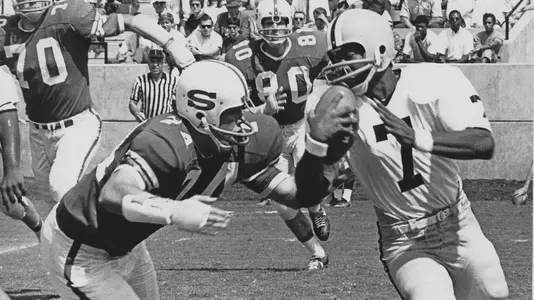
Wake Forest Sports Hall of Fame 2020 Inductee Profile: Freddie Summers
2/4/2020 12:54:00 PM | Football, Les Johns
Summers was a culture-changing figure in college football. His ascendancy to becoming a starting quarterback in the ACC helped pave the way for his contemporaries.
Freddie Summers shattered barriers and earned All-ACC recognition as the first black quarterback in the ACC and leading the league in total offense as a junior in 1967.
Summers was inducted as part of the Wake Forest Sports Hall of Fame class of 2020 on Saturday during halftime of the home basketball game against Clemson.
"He was a monster," said R. Steve Bowden, a former Wake Forest running back and wide receiver who is now a member of the Hall of Fame committee. "Freddie called his own plays. He was a unique, high-quality, supreme athlete.
"You put him in these offenses they're running now, and there's no telling what he would do. He could run a 4.4 40-yard dash with a good arm and a great mind. He went on the field and ran the offense. He was a special guy."
When Bowden, an all-conference player from a Randolph County High School that had just desegregated in 1965, came to Wake Forest for a recruiting visit, Summers was his host.
"To go and be next to this guy who is an All-ACC quarterback — to me that was something," Bowden said. "That was special. I was in awe, but I'm sure he wasn't. I was the one taking up his Saturday night.
"He took me around to show me the university and introduced me to the other guys. I was set then. I was heavily recruited. I visited North Carolina six times. Duke and NC State offered me scholarships, as did schools from the Big Ten and the Big Eight."
The personal attention from Summers and the accommodating atmosphere at Wake Forest made the decision easy form Bowden.
"Wake Forest had me from the word go, and Freddie just solidified it," he said. "He was such a cool guy, and was always good to me."
Howard Stanback played center for the Deacons on those teams with Summers.
"Not only was Freddie Summers the quarterback, but you actually had a black center snapping the ball," Bowden noted. "Wake had a solid team of high-skill, solid black players. We just accepted the fact that Wake had us there. We never sat around and appreciated the significance of what was happening."
Bowden indicated that Wake Forest was ahead of the curve by five or six years and that helped him feel more at ease about the issues often faced by African-Americans during the era of desegregation.
"You won't have to worry about that at Wake," Bowden was told. "We got past that."
He said he really appreciated that guidance.
"It wasn't a piece of cake," Bowden said. "There were still some issues."
In his two seasons at quarterback for the Deacs after transferring from a Nebraska junior college, Summers completed 202-of-409 passes for 2,573 yards and 11 touchdowns. He ran for another 949 yards and 17 scores.
"He was an All-ACC quarterback back in the day when there surely wasn't anybody trying to be politically correct," Bowden said. "He wasn't getting a vote because people were trying to do something nice. He was just so much better than his peers at that time. He was a special guy. He performed and performed at a high level.
"If he'd just been the first black quarterback, that would have been significant to me. But then to be recognized as the 'top' quarterback, who just happened to be black was even a greater achievement."
The recognition for Summers came on Saturday as the Heritage candidate, which recognizes Wake Forest athletes who completed their career more than 40 years ago. Then-Wake Forest coach Bill Tate recruited Summers, then named him as the starter in the second game of the 1967 season as the Deacs traveled to Clemson.
After two seasons with the Deacons, Summers was drafted in the fourth round of the 1969 NFL Draft by the Cleveland Browns. After being converted to a defensive back, Summers is credited with the very first tackle in the history of Monday Night Football as part of the kickoff team for the Browns in September of 1970. Summers corralled Jets kick returner Steve Tannen on the opening kickoff.
Summers passed away at the age of 47 in 1994.
Though his role as the first black quarterback in the South was significant, it's not something Summers contemplated much at the time, according to Bowden.
"He just wanted to play, and Wake Forest gave him a chance to play," Bowden said. "He wasn't looking to make any statements or break any barriers. He just wanted to participate and play."
Freddie was a culture-changing figure in college football. His ascendancy to becoming a starting quarterback in the ACC helped pave the way for his contemporaries, such as Condredge Holloway, who became the first black quarterback in the SEC while playing at Tennessee in the early 1970s.
Summers may only be at the Hall of Fame induction in spirit, but his accomplishments certainly have not been forgotten.
Summers was inducted as part of the Wake Forest Sports Hall of Fame class of 2020 on Saturday during halftime of the home basketball game against Clemson.
"He was a monster," said R. Steve Bowden, a former Wake Forest running back and wide receiver who is now a member of the Hall of Fame committee. "Freddie called his own plays. He was a unique, high-quality, supreme athlete.
"You put him in these offenses they're running now, and there's no telling what he would do. He could run a 4.4 40-yard dash with a good arm and a great mind. He went on the field and ran the offense. He was a special guy."
When Bowden, an all-conference player from a Randolph County High School that had just desegregated in 1965, came to Wake Forest for a recruiting visit, Summers was his host.
"To go and be next to this guy who is an All-ACC quarterback — to me that was something," Bowden said. "That was special. I was in awe, but I'm sure he wasn't. I was the one taking up his Saturday night.
"He took me around to show me the university and introduced me to the other guys. I was set then. I was heavily recruited. I visited North Carolina six times. Duke and NC State offered me scholarships, as did schools from the Big Ten and the Big Eight."
The personal attention from Summers and the accommodating atmosphere at Wake Forest made the decision easy form Bowden.
"Wake Forest had me from the word go, and Freddie just solidified it," he said. "He was such a cool guy, and was always good to me."
Howard Stanback played center for the Deacons on those teams with Summers.
"Not only was Freddie Summers the quarterback, but you actually had a black center snapping the ball," Bowden noted. "Wake had a solid team of high-skill, solid black players. We just accepted the fact that Wake had us there. We never sat around and appreciated the significance of what was happening."
Bowden indicated that Wake Forest was ahead of the curve by five or six years and that helped him feel more at ease about the issues often faced by African-Americans during the era of desegregation.
"You won't have to worry about that at Wake," Bowden was told. "We got past that."
He said he really appreciated that guidance.
"It wasn't a piece of cake," Bowden said. "There were still some issues."
In his two seasons at quarterback for the Deacs after transferring from a Nebraska junior college, Summers completed 202-of-409 passes for 2,573 yards and 11 touchdowns. He ran for another 949 yards and 17 scores.
"He was an All-ACC quarterback back in the day when there surely wasn't anybody trying to be politically correct," Bowden said. "He wasn't getting a vote because people were trying to do something nice. He was just so much better than his peers at that time. He was a special guy. He performed and performed at a high level.
"If he'd just been the first black quarterback, that would have been significant to me. But then to be recognized as the 'top' quarterback, who just happened to be black was even a greater achievement."
The recognition for Summers came on Saturday as the Heritage candidate, which recognizes Wake Forest athletes who completed their career more than 40 years ago. Then-Wake Forest coach Bill Tate recruited Summers, then named him as the starter in the second game of the 1967 season as the Deacs traveled to Clemson.
After two seasons with the Deacons, Summers was drafted in the fourth round of the 1969 NFL Draft by the Cleveland Browns. After being converted to a defensive back, Summers is credited with the very first tackle in the history of Monday Night Football as part of the kickoff team for the Browns in September of 1970. Summers corralled Jets kick returner Steve Tannen on the opening kickoff.
Summers passed away at the age of 47 in 1994.
Though his role as the first black quarterback in the South was significant, it's not something Summers contemplated much at the time, according to Bowden.
"He just wanted to play, and Wake Forest gave him a chance to play," Bowden said. "He wasn't looking to make any statements or break any barriers. He just wanted to participate and play."
Freddie was a culture-changing figure in college football. His ascendancy to becoming a starting quarterback in the ACC helped pave the way for his contemporaries, such as Condredge Holloway, who became the first black quarterback in the SEC while playing at Tennessee in the early 1970s.
Summers may only be at the Hall of Fame induction in spirit, but his accomplishments certainly have not been forgotten.


Sunday, May 31
Tuesday, May 19
Wednesday, April 22
Wednesday, April 22