Wake Forest Athletics
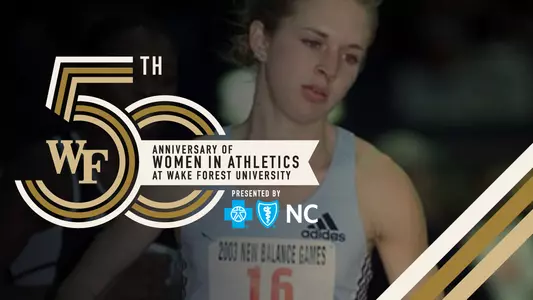
Deacon Sports Xtra: All-American Jill Kerr Attributes Success to Relationships with Teammates
11/4/2021 12:46:00 PM | Track and Field, Les Johns
Jill Kerr won four ACC championships and earned seven All-ACC awards, competing in the Mile, the 800-meter and the distance medley relay.
Jill Snyder Kerr was a school record-breaking All-American track and field star who was probably a little ahead of her time.
A freshman injury caused some deep soul searching for Kerr and a reevaluation of her training habits, which at times clashed with the Wake Forest coaching staff. What led to great acrimony in the late 90s is essentially encouraged in modern-day athletics, appropriately labeled as load management.
She suffered a knee injury in November of her freshman year and had surgery at the end of the semester, heading home to Pennsylvania during the Christmas break to begin her rehab.
"That was a huge setback, not just physically, but mentally," Kerr said. "I was really to go emotionally and had high goals. I finished my high school career ranked fourth-fastest in the country at my event. So I was ready to come in and be an All-American right away."
"I had to go back to ground zero, heal and rebuild strength. That was really hard. The rest of my freshman year was really difficult. There's such a connection between your psychological state and being able to do what you love."
Kerr wasn't physically able to compete in the indoor season and wasn't really 100 percent for the outdoor events, but she entered several events anyway.
"I wasn't a very patient person," Kerr admits. "I look back as an adult, and it was just two months. I should have redshirted that outdoor season, but I competed to the best of my ability. I couldn't run the way I wanted to, and got hurt again, which isn't uncommon when you're dealing with something like that."
The summer between her freshman and sophomore seasons Kerr spent a lot of time pondering her future.
It was over the summer that I did some soul-searching about whether Wake Forest was the right fit.
"I even considered transferring," she said. "I was really unhappy, mostly because of the injury. But I really loved my teammates. I knew I had some communication challenges with my coach. But I knew I needed to be all in or not — I couldn't be riding the fence or do my own thing. I ultimately decided that this was the team I wanted to be a part of."
"I worked through it, went home and regrouped — and I stuck it out."
Kerr started hitting her stride as an athlete as soon as she returned for her sophomore season, starting with frank conversations with her coaching staff.
"My sophomore year I found myself as an athlete, and found the sweet spot of how I needed to push myself and where I needed to be smarter," she said. "I just had to take care of some things surrounding training and my personal health. In terms of reaching my full potential, I can't do as much volume as your traditional cross-country runner. So I had to stand my ground on that with my coaches.
"We just got it all out in the open. I did less volume running, but more work in the weight room, which is the modification we made. I worked really hard, but kept a close eye on the number of miles that I ran per week, in addition to building in recovery time. I wanted to make sure I got enough sleep and the other things you have to do when you're training at a high level."
Those lessons really paid dividends later in life for Kerr as she became a coach herself, vowing to keep an open line of communication with the athletes under her tutelage.
"We sorted it out," Kerr said about the conflict as a sophomore. "I just worked really hard to keep the lines of communication as an athlete. I've been a coach since I graduated, and the frustrations on the communication piece impacts what I do everyday. I know how important that is, being on the same page as your athletes."
Kerr won four ACC championships and earned seven All-ACC awards, competing in the Mile, the 800-meter and the distance medley relay.
"The best memories are the team championships," she said. "The DMR championship we won was awesome, and then as a coach when we won the 2002 cross country championship was great."
She earned All-American honors in both the mile and the distance medley relay in 2001, and was named the Wake Forest Female Scholar-Athlete of the Year in 1998-99. The individual title she most cherishes in the indoor 1500 ACC Championship, in 2000.
"That was the one that eluded me the first two years, where I came in as a runner-up," Kerr. "I had to race in a completely different way, to surpass this one particular competitor of mine from Georgia Tech, who had beaten me the previous two years."
The Wake Forest staff reached out to Kerr in the recruiting process just in the nick of time. She had one official visit left to use, and ended up in Winston-Salem to see what Wake Forest was all about.
"I came and saw the campus, and it was beautiful," she said. "The timing worked out really well. They offered me a scholarship and I was excited to accept. I was ready after a couple of rough Pennsylvania winters —the blizzards of '93 and '94 — I was ready to train in a warmer climate.
"I was also excited about the strong academics and the small size of the school. That was something I was used to, so I thought it was the best of both worlds — strong academics and athletics."
Kerr coached at Wake Forest four years, and then worked as a volunteer on the Boston College staff with her husband Matt Kerr, who is in his 13th season leading the Eagles. The Kerr's also started their family, which doubled in size instantly when her third pregnancy produced triplets.
"It was astonishing," she said. "Instant triplets. I was exhausted when I went there eight-weeks in. It was the shock of my life. Laughing, crying — it was a shock. That pregnancy was really hard. I was grateful every day I was an athlete. It was 35 weeks of the toughest interval workout of my life. It was intense, but they all arrived safely and are doing great."
The Kerrs have started a youth track program, and Jill is coaching track for students grades 6-12, giving her the opportunity to coach her oldest daughter.
"It's been the full spectrum, coaching little kids all the way up to collegiate athletes," Kerr said.
The lessons she learned as a student-athlete during her All-American career at Wake Forest has helped guide her throughout life.
"What ultimately has helped me so much through my life, whether professionally, as a mother or through that difficult pregnancy was just learning to build upon my strengths and to try to focus on those more than on the natural weaknesses," she said. "Sometimes as an athlete, we focus too much on the areas in which we need to improve. That can physiologically be detrimental. So it's building on our strengths. That's my philosophy as a coach as well.
"Figure out where the strengths are and build on them. That's what being a coach is all about. It's just 10 percent working on the weaknesses."
She attributes her success to the relationships she built with her Demon Deacon teammates.
"I was blessed to be teammates with some incredible athletes and even better people," Kerr said. "The athletics and the degree — I'm so grateful for those things. But friendships are equally as important. Helping each other out through the ups and downs of competition and training was really special."
A freshman injury caused some deep soul searching for Kerr and a reevaluation of her training habits, which at times clashed with the Wake Forest coaching staff. What led to great acrimony in the late 90s is essentially encouraged in modern-day athletics, appropriately labeled as load management.
She suffered a knee injury in November of her freshman year and had surgery at the end of the semester, heading home to Pennsylvania during the Christmas break to begin her rehab.
"That was a huge setback, not just physically, but mentally," Kerr said. "I was really to go emotionally and had high goals. I finished my high school career ranked fourth-fastest in the country at my event. So I was ready to come in and be an All-American right away."
"I had to go back to ground zero, heal and rebuild strength. That was really hard. The rest of my freshman year was really difficult. There's such a connection between your psychological state and being able to do what you love."
Kerr wasn't physically able to compete in the indoor season and wasn't really 100 percent for the outdoor events, but she entered several events anyway.
"I wasn't a very patient person," Kerr admits. "I look back as an adult, and it was just two months. I should have redshirted that outdoor season, but I competed to the best of my ability. I couldn't run the way I wanted to, and got hurt again, which isn't uncommon when you're dealing with something like that."
The summer between her freshman and sophomore seasons Kerr spent a lot of time pondering her future.
It was over the summer that I did some soul-searching about whether Wake Forest was the right fit.
"I even considered transferring," she said. "I was really unhappy, mostly because of the injury. But I really loved my teammates. I knew I had some communication challenges with my coach. But I knew I needed to be all in or not — I couldn't be riding the fence or do my own thing. I ultimately decided that this was the team I wanted to be a part of."
"I worked through it, went home and regrouped — and I stuck it out."
Kerr started hitting her stride as an athlete as soon as she returned for her sophomore season, starting with frank conversations with her coaching staff.
"My sophomore year I found myself as an athlete, and found the sweet spot of how I needed to push myself and where I needed to be smarter," she said. "I just had to take care of some things surrounding training and my personal health. In terms of reaching my full potential, I can't do as much volume as your traditional cross-country runner. So I had to stand my ground on that with my coaches.
"We just got it all out in the open. I did less volume running, but more work in the weight room, which is the modification we made. I worked really hard, but kept a close eye on the number of miles that I ran per week, in addition to building in recovery time. I wanted to make sure I got enough sleep and the other things you have to do when you're training at a high level."
Those lessons really paid dividends later in life for Kerr as she became a coach herself, vowing to keep an open line of communication with the athletes under her tutelage.
"We sorted it out," Kerr said about the conflict as a sophomore. "I just worked really hard to keep the lines of communication as an athlete. I've been a coach since I graduated, and the frustrations on the communication piece impacts what I do everyday. I know how important that is, being on the same page as your athletes."
Kerr won four ACC championships and earned seven All-ACC awards, competing in the Mile, the 800-meter and the distance medley relay.
"The best memories are the team championships," she said. "The DMR championship we won was awesome, and then as a coach when we won the 2002 cross country championship was great."
She earned All-American honors in both the mile and the distance medley relay in 2001, and was named the Wake Forest Female Scholar-Athlete of the Year in 1998-99. The individual title she most cherishes in the indoor 1500 ACC Championship, in 2000.
"That was the one that eluded me the first two years, where I came in as a runner-up," Kerr. "I had to race in a completely different way, to surpass this one particular competitor of mine from Georgia Tech, who had beaten me the previous two years."
The Wake Forest staff reached out to Kerr in the recruiting process just in the nick of time. She had one official visit left to use, and ended up in Winston-Salem to see what Wake Forest was all about.
"I came and saw the campus, and it was beautiful," she said. "The timing worked out really well. They offered me a scholarship and I was excited to accept. I was ready after a couple of rough Pennsylvania winters —the blizzards of '93 and '94 — I was ready to train in a warmer climate.
"I was also excited about the strong academics and the small size of the school. That was something I was used to, so I thought it was the best of both worlds — strong academics and athletics."
Kerr coached at Wake Forest four years, and then worked as a volunteer on the Boston College staff with her husband Matt Kerr, who is in his 13th season leading the Eagles. The Kerr's also started their family, which doubled in size instantly when her third pregnancy produced triplets.
"It was astonishing," she said. "Instant triplets. I was exhausted when I went there eight-weeks in. It was the shock of my life. Laughing, crying — it was a shock. That pregnancy was really hard. I was grateful every day I was an athlete. It was 35 weeks of the toughest interval workout of my life. It was intense, but they all arrived safely and are doing great."
The Kerrs have started a youth track program, and Jill is coaching track for students grades 6-12, giving her the opportunity to coach her oldest daughter.
"It's been the full spectrum, coaching little kids all the way up to collegiate athletes," Kerr said.
The lessons she learned as a student-athlete during her All-American career at Wake Forest has helped guide her throughout life.
"What ultimately has helped me so much through my life, whether professionally, as a mother or through that difficult pregnancy was just learning to build upon my strengths and to try to focus on those more than on the natural weaknesses," she said. "Sometimes as an athlete, we focus too much on the areas in which we need to improve. That can physiologically be detrimental. So it's building on our strengths. That's my philosophy as a coach as well.
"Figure out where the strengths are and build on them. That's what being a coach is all about. It's just 10 percent working on the weaknesses."
She attributes her success to the relationships she built with her Demon Deacon teammates.
"I was blessed to be teammates with some incredible athletes and even better people," Kerr said. "The athletics and the degree — I'm so grateful for those things. But friendships are equally as important. Helping each other out through the ups and downs of competition and training was really special."
Men's Basketball Postgame Presser vs. Clemson, 2026 ACC Tournament
Thursday, March 12
Wake Forest Women's Basketball: Marcy Carter Women's History Month Feature
Wednesday, March 11
Sebastian Akins Tough
Wednesday, March 11
Wake Forest Advances in 2026 ACC Tournament
Wednesday, March 11