Wake Forest Athletics
11/25/2026 10:55:00 AM | Baseball, Football, General, Men's Basketball
Wake Forest Athletics will hold the fifth-annual Trailblazer Award ceremony on Jan. 16, 2027 inside Bridger Field House.
REGISTER FOR CEREMONY
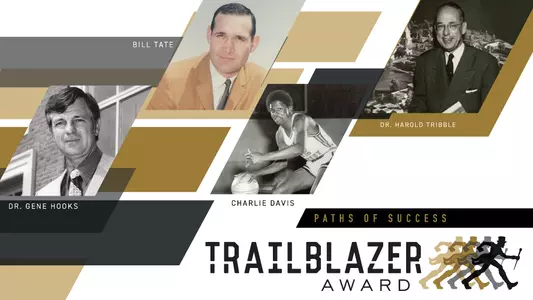
WINSTON-SALEM, N.C. – Wake Forest University is proud to announce four recipients of the 2026-27 Trailblazer Award – men's basketball legend Charlie Davis, Wake Forest Sports Hall of Famer Dr. Gene Hooks, former university president Dr. Harold Tribble and renowned football coach Bill Tate.
Davis will be enshrined in the Trailblazer Award ceremony on Jan. 16, 2027 while Hooks, Tribble and Tate will be posthumously honored during the event. The ceremony is set to be held in the Snead Room inside Bridger Field House. Doors will open at 2 p.m., with a start time scheduled for 2:30 p.m.
Fans and members of the Winston-Salem community who are interested in attending the event can contact Ella Harrison (harriel@wfu.edu) for more information.
Following the ceremony, an additional recognition will take place during the Wake Forest men's basketball game versus Florida State that afternoon. Tipoff is set for 4:30 p.m. inside LJVM Coliseum.
The Wake Forest Trailblazer award was created in 2021, named in honor of the first Black football student-athletes to enroll at a Division I institution in the South – Robert Grant and Kenneth "Butch" Henry. Three of this year's honorees had a connection to the two football players during their time at Wake Forest. In the fall of 1964, Bill Tate recruited Grant and Henry as a defensive lineman and wide receiver, respectively. Both Grant and Henry went on to credit Athletic Director Dr. Hooks and Wake Forest President Harold Tribble with integrating intercollegiate athletics and enabling them to fulfill their dreams.
"Charlie Davis, Gene Hooks, Harold Tribble, and Bill Tate. Wake Forest University owes these Demon Deacons a debt of gratitude for their courage, their vision, their talent, and their unwavering hearts for excellence, competition, and community," said Wake Forest President Peter Rodriguez. "Each of these trailblazers made Wake Forest University better through their belief in the value of a diverse community. Their actions called us to be a university where more were welcome and where we held ourselves more faithfully to our motto, Pro Humanitate."
"This year's honorees changed Wake Forest athletics for everyone who came after them," said Vice President & Director of Athletics John Currie. "Dr. Gene Hooks, President Harold Tribble and Coach Bill Tate made a decision in 1964 that opened doors for generations of student-athletes. Charlie Davis is one of the most impactful players to ever compete in the ACC, and he remains a presence in our program, inspiring today's student-athletes. It is a privilege to honor these four Demon Deacons who represent the best of Wake Forest."
Previous Trailblazer Award Honorees:
Charlie Davis, Men's Basketball
One of the all-time greats in the history of Demon Deacons men's basketball, Charlie Davis competed for the program from 1969-71. He was the second African-American male to don a Wake Forest basketball jersey and the first black player to win ACC Player of the Year in 1971.
Davis still holds three school records – career scoring average (tied for first at 24.94 points per game); career free-throw accuracy (87.3 percent); and single-game scoring (51 points). His 51-point game against American came in the Memorial Coliseum on Feb. 15, 1969. Davis went 19-of-27 from the field and 13-of-14 on free throws. The Deacons won 105-81, as he scored 35 of the team's 56 second half points.
Davis' uniform (No. 12) was the third to be retired by the men's basketball program. He was named to the All-ACC team each of his three years as a roster member. In 1970, Davis received the Arnold Palmer Award as Wake Forest's Athlete of the Year. His final home game, on March 2, 1971 against Maryland, was proclaimed "Charlie Davis Night" at the Memorial Coliseum.
Following his collegiate career, Davis spent three seasons in the NBA with the Cleveland Cavaliers and Portland Trail Blazers, averaging 8.9 points per game as a professional. He returned to Wake Forest years later to officially graduate in 1990.
Davis was inducted into the Wake Forest Sports Hall of Fame in 1984 and named to the ACC's 50th Anniversary team in 2002. He went on to serve as an assistant athletic director at Wake Forest and as the athletic director at nearby North Carolina A&T. Last year, he was named a recipient of the 2025 ACC Unite Award – honoring league-affiliated individuals who have made an impact in the areas of racial and social justice.
Dr. Gene Hooks, Distinguished Faculty Member & Baseball
A Demon Deacon who has had an everlasting impact on Wake Forest, Dr. Gene Hooks competed as an All-American baseball player before dedicating 36 years as an administrator, including 28 as Director of Athletics. His leadership and courage were just two of his many characteristics as he became a significant figure in the history of the Atlantic Coast Conference.
Hooks began his athletic journey as a three-sport athlete at Rocky Mount High School. After enrolling at Wake Forest College, Hooks was named an All-American third baseman in 1949 and 1950 while helping the Deacs to a runner-up finish in the 1949 College World Series as a member of the All-Tournament Team. He was a career .335 hitter for Wake Forest. In 2025, Hooks was inducted into the College Baseball Hall of Fame.
After graduation, Hooks signed with the Chicago Cubs and played pro baseball for five years before returning to work on his postgraduate degree in physical education from Wake Forest. He went on to earn his master's degree from the University of North Carolina in 1952 and served as an instructor in physical education at N.C. State. He also earned his doctorate in education and physical education from George Peabody College.
Hooks returned to Wake Forest in 1956 as a PE instructor and baseball coach. He was the head baseball coach for three years before returning to the classroom as a professor. In 1964, he became the school's fourth Athletic Director and earned a reputation as an innovator in promotions. He oversaw the construction of many of the athletics facilities. Under his guidance, capital improvements included the construction of Allegacy Federal Credit Union Stadium, Lawrence Joel Veterans Memorial Coliseum, Leighton Tennis Stadium, the Arnold Palmer Golf Complex, sports medicine clinic, Manchester Athletic Center and the creation of the Wake Forest Sports Hall of Fame. He was a sound financial manager, with athletic department revenues increasing more than tenfold under his tenure. Wake Forest recognized Hooks' lifelong commitment to its athletic program by naming the baseball stadium after him in 1988. The Deacons won three national championships and 21 ACC titles during his tenure.
Hooks retired from Wake Forest in the summer of 1992 and received the Medallion of Merit – the highest award presented by Wake Forest – for distinguished service in 1993. In his first year of eligibility, Hooks was inducted into the Wake Forest Sports Hall of Fame for his work in elevating the athletics department. He became the first executive director of the Division I-A Athletic Directors Association and served in that role until 1997. He also became one of the founders of the Great Eight Basketball Festival and was inducted into the North Carolina Sports Hall of Fame in 1999.
In 2007, in honor of Dr. Hooks, Wake Forest created the inaugural Gene Hooks Lifetime Achievement Award. The award recognizes a former Wake Forest athlete, manager, coach or administrator who has exhibited traits of integrity, charity and leadership and embodies the Pro Humanitate spirit that Dr. Gene Hooks demonstrated over his 45 years associated with Wake Forest.
Hooks passed away on April 6, 2026, at the age of 98.
Bill Tate, Football
A pioneering leader who left a lasting mark on college athletics and the Wake Forest University community, former head football coach Bill Tate led the Demon Deacons program from 1964-68. He is remembered for playing a pivotal role in integrating Southern collegiate athletics. In the fall of 1964, Tate recruited defensive lineman Bob Grant and wide receiver Butch Henry—two of the first Black student-athletes at Wake Forest.
The integration movement at Wake Forest began with a critical conversation between Tate and then-University President Harold Tribble. Subsequently, Wake Forest was positioned as a standard bearer for racial progress in Southern intercollegiate athletics. With courage and conviction, Tate helped Wake Forest become the first university in the South to integrate Black student-athletes in 1964.
That same 1964 season saw the Deacs finish with a 5–5 record, and Tate was named ACC Coach of the Year. During his time at the helm, he was instrumental in assembling the football roster that would go on to win the 1970 ACC Championship.
Before his coaching days, Grant emerged as a standout player for the University of Illinois. He was selected 50th overall in the 1968 NFL Draft by the Baltimore Colts and went on to play in two Super Bowls, earning a championship ring in Super Bowl V with a 16–13 victory over the Dallas Cowboys.
Before arriving at Wake Forest, Tate coached at his alma mater from 1959–63. As a player from 1950–52, he earned MVP honors in the 1952 Rose Bowl after rushing for 150 yards and scoring two touchdowns in a 40–7 win over Stanford. He was inducted into the Rose Bowl Hall of Fame in 1996.
Tate passed away on June 23, 2025 at the age of 93.
Dr. Harold Tribble, Former Wake Forest President
Dr. Harold Tribble served as the 10th President for Wake Forest from 1950-67. He is remembered for having a key role in a number of transformational moves - including the transition of the college becoming a university, integration of the student body and the formation of the ACC.
Tribble was officially elected president on May 4, 1950. As part of his selection, Tribble agreed to the College's move from Wake County to Winston-Salem, NC, in conjunction with the Z. Smith Reynolds Foundation. As a new Winston-Salem campus opened on June 18, 1956. Wake Forest's equity grew exponentially. Additionally, the student body expanded from 1,750 to more than 3,000 individuals with an increased academic rigor, as faculty numbers also saw a significant increase. In January 1967, as a result of these developments, the Board of Trustees voted to rename the College Wake Forest University. Tribble retired in June 1967 after 17 years as president.
During his earlier years, Tribble enrolled at Columbia College in 1915 and, in 1917, transferred to Richmond College (now the University of Richmond), where he played varsity basketball and served as editor-in-chief of the Collegian student newspaper as a senior. Tribble graduated in 1919 with an A.B. degree. In 1922, he earned a master's degree in theology and taught at The Southern Baptist Theological Seminary (SBTS) while earning his doctorate in theology in 1925.
In 1929, Tribble returned to SBTS as a full professor. After a year at Southern Baptist, he studied abroad extensively. Tribble enrolled at the University of Bonn, Germany, in 1931 and the University of Basel, Switzerland, in 1936. In 1937, he earned another doctorate – this time from the University of Edinburgh in Scotland. In 1947, three years prior to his time at Wake Forest College, Tribble moved into administration when he was appointed president of Andover Newton Theological School in Newton Center, MA.
The university's Tribble Hall, completed in 1963, was named in honor of Tribble and stands as one of the most prominent academic buildings on campus. Tribble passed away on June 17, 1986 at the age of 86.
About the Trailblazer Award
The Robert Grant and Kenneth "Butch" Henry Trailblazer Award was created to recognize the significance of the first Black football players at Wake Forest University and the historical role Wake Forest Athletics played in integrating Division I sports in the South. Being the first Black football players took Courage to take to the field on behalf of their teammates and the Wake Forest community, despite the risks. It took deep Faith to believe that their teammates, the coaching staff, and the Wake Forest community would offer steady support during critical times. As Transformational leaders, it took Trusting in their abilities, talents and tremendous fortitude to persevere, that would set trails, often not traveled, ablaze, lighting the way and leaving paths of success for all of the athletes yet to come in the south. Hence, this award celebrates Wake Forest student-athletes, alumni, staff and community members who have blazed trails in the areas of diversity, inclusion, equity and other important social issues that better the lives of others in the Pro Humanitate tradition that is the central spirit of Wake Forest University.
There is no minimum or maximum number of honorees per year, and nominees (which can be sent to wfsports@wfu.edu) will be reviewed by the Trailblazer Award Committee.
Trailblazer Award Committee
WINSTON-SALEM, N.C. – Wake Forest University is proud to announce four recipients of the 2026-27 Trailblazer Award – men's basketball legend Charlie Davis, Wake Forest Sports Hall of Famer Dr. Gene Hooks, former university president Dr. Harold Tribble and renowned football coach Bill Tate.
Davis will be enshrined in the Trailblazer Award ceremony on Jan. 16, 2027 while Hooks, Tribble and Tate will be posthumously honored during the event. The ceremony is set to be held in the Snead Room inside Bridger Field House. Doors will open at 2 p.m., with a start time scheduled for 2:30 p.m.
Fans and members of the Winston-Salem community who are interested in attending the event can contact Ella Harrison (harriel@wfu.edu) for more information.
Following the ceremony, an additional recognition will take place during the Wake Forest men's basketball game versus Florida State that afternoon. Tipoff is set for 4:30 p.m. inside LJVM Coliseum.
The Wake Forest Trailblazer award was created in 2021, named in honor of the first Black football student-athletes to enroll at a Division I institution in the South – Robert Grant and Kenneth "Butch" Henry. Three of this year's honorees had a connection to the two football players during their time at Wake Forest. In the fall of 1964, Bill Tate recruited Grant and Henry as a defensive lineman and wide receiver, respectively. Both Grant and Henry went on to credit Athletic Director Dr. Hooks and Wake Forest President Harold Tribble with integrating intercollegiate athletics and enabling them to fulfill their dreams.
"Charlie Davis, Gene Hooks, Harold Tribble, and Bill Tate. Wake Forest University owes these Demon Deacons a debt of gratitude for their courage, their vision, their talent, and their unwavering hearts for excellence, competition, and community," said Wake Forest President Peter Rodriguez. "Each of these trailblazers made Wake Forest University better through their belief in the value of a diverse community. Their actions called us to be a university where more were welcome and where we held ourselves more faithfully to our motto, Pro Humanitate."
"This year's honorees changed Wake Forest athletics for everyone who came after them," said Vice President & Director of Athletics John Currie. "Dr. Gene Hooks, President Harold Tribble and Coach Bill Tate made a decision in 1964 that opened doors for generations of student-athletes. Charlie Davis is one of the most impactful players to ever compete in the ACC, and he remains a presence in our program, inspiring today's student-athletes. It is a privilege to honor these four Demon Deacons who represent the best of Wake Forest."
Previous Trailblazer Award Honorees:
- 2025-26:
- 2024-25:
- 2023-24:
- 2021-22:
Charlie Davis, Men's Basketball
One of the all-time greats in the history of Demon Deacons men's basketball, Charlie Davis competed for the program from 1969-71. He was the second African-American male to don a Wake Forest basketball jersey and the first black player to win ACC Player of the Year in 1971.
Davis still holds three school records – career scoring average (tied for first at 24.94 points per game); career free-throw accuracy (87.3 percent); and single-game scoring (51 points). His 51-point game against American came in the Memorial Coliseum on Feb. 15, 1969. Davis went 19-of-27 from the field and 13-of-14 on free throws. The Deacons won 105-81, as he scored 35 of the team's 56 second half points.
Davis' uniform (No. 12) was the third to be retired by the men's basketball program. He was named to the All-ACC team each of his three years as a roster member. In 1970, Davis received the Arnold Palmer Award as Wake Forest's Athlete of the Year. His final home game, on March 2, 1971 against Maryland, was proclaimed "Charlie Davis Night" at the Memorial Coliseum.
Following his collegiate career, Davis spent three seasons in the NBA with the Cleveland Cavaliers and Portland Trail Blazers, averaging 8.9 points per game as a professional. He returned to Wake Forest years later to officially graduate in 1990.
Davis was inducted into the Wake Forest Sports Hall of Fame in 1984 and named to the ACC's 50th Anniversary team in 2002. He went on to serve as an assistant athletic director at Wake Forest and as the athletic director at nearby North Carolina A&T. Last year, he was named a recipient of the 2025 ACC Unite Award – honoring league-affiliated individuals who have made an impact in the areas of racial and social justice.
Dr. Gene Hooks, Distinguished Faculty Member & Baseball
A Demon Deacon who has had an everlasting impact on Wake Forest, Dr. Gene Hooks competed as an All-American baseball player before dedicating 36 years as an administrator, including 28 as Director of Athletics. His leadership and courage were just two of his many characteristics as he became a significant figure in the history of the Atlantic Coast Conference.
Hooks began his athletic journey as a three-sport athlete at Rocky Mount High School. After enrolling at Wake Forest College, Hooks was named an All-American third baseman in 1949 and 1950 while helping the Deacs to a runner-up finish in the 1949 College World Series as a member of the All-Tournament Team. He was a career .335 hitter for Wake Forest. In 2025, Hooks was inducted into the College Baseball Hall of Fame.
After graduation, Hooks signed with the Chicago Cubs and played pro baseball for five years before returning to work on his postgraduate degree in physical education from Wake Forest. He went on to earn his master's degree from the University of North Carolina in 1952 and served as an instructor in physical education at N.C. State. He also earned his doctorate in education and physical education from George Peabody College.
Hooks returned to Wake Forest in 1956 as a PE instructor and baseball coach. He was the head baseball coach for three years before returning to the classroom as a professor. In 1964, he became the school's fourth Athletic Director and earned a reputation as an innovator in promotions. He oversaw the construction of many of the athletics facilities. Under his guidance, capital improvements included the construction of Allegacy Federal Credit Union Stadium, Lawrence Joel Veterans Memorial Coliseum, Leighton Tennis Stadium, the Arnold Palmer Golf Complex, sports medicine clinic, Manchester Athletic Center and the creation of the Wake Forest Sports Hall of Fame. He was a sound financial manager, with athletic department revenues increasing more than tenfold under his tenure. Wake Forest recognized Hooks' lifelong commitment to its athletic program by naming the baseball stadium after him in 1988. The Deacons won three national championships and 21 ACC titles during his tenure.
Hooks retired from Wake Forest in the summer of 1992 and received the Medallion of Merit – the highest award presented by Wake Forest – for distinguished service in 1993. In his first year of eligibility, Hooks was inducted into the Wake Forest Sports Hall of Fame for his work in elevating the athletics department. He became the first executive director of the Division I-A Athletic Directors Association and served in that role until 1997. He also became one of the founders of the Great Eight Basketball Festival and was inducted into the North Carolina Sports Hall of Fame in 1999.
In 2007, in honor of Dr. Hooks, Wake Forest created the inaugural Gene Hooks Lifetime Achievement Award. The award recognizes a former Wake Forest athlete, manager, coach or administrator who has exhibited traits of integrity, charity and leadership and embodies the Pro Humanitate spirit that Dr. Gene Hooks demonstrated over his 45 years associated with Wake Forest.
Hooks passed away on April 6, 2026, at the age of 98.
Bill Tate, Football
A pioneering leader who left a lasting mark on college athletics and the Wake Forest University community, former head football coach Bill Tate led the Demon Deacons program from 1964-68. He is remembered for playing a pivotal role in integrating Southern collegiate athletics. In the fall of 1964, Tate recruited defensive lineman Bob Grant and wide receiver Butch Henry—two of the first Black student-athletes at Wake Forest.
The integration movement at Wake Forest began with a critical conversation between Tate and then-University President Harold Tribble. Subsequently, Wake Forest was positioned as a standard bearer for racial progress in Southern intercollegiate athletics. With courage and conviction, Tate helped Wake Forest become the first university in the South to integrate Black student-athletes in 1964.
That same 1964 season saw the Deacs finish with a 5–5 record, and Tate was named ACC Coach of the Year. During his time at the helm, he was instrumental in assembling the football roster that would go on to win the 1970 ACC Championship.
Before his coaching days, Grant emerged as a standout player for the University of Illinois. He was selected 50th overall in the 1968 NFL Draft by the Baltimore Colts and went on to play in two Super Bowls, earning a championship ring in Super Bowl V with a 16–13 victory over the Dallas Cowboys.
Before arriving at Wake Forest, Tate coached at his alma mater from 1959–63. As a player from 1950–52, he earned MVP honors in the 1952 Rose Bowl after rushing for 150 yards and scoring two touchdowns in a 40–7 win over Stanford. He was inducted into the Rose Bowl Hall of Fame in 1996.
Tate passed away on June 23, 2025 at the age of 93.
Dr. Harold Tribble, Former Wake Forest President
Dr. Harold Tribble served as the 10th President for Wake Forest from 1950-67. He is remembered for having a key role in a number of transformational moves - including the transition of the college becoming a university, integration of the student body and the formation of the ACC.
Tribble was officially elected president on May 4, 1950. As part of his selection, Tribble agreed to the College's move from Wake County to Winston-Salem, NC, in conjunction with the Z. Smith Reynolds Foundation. As a new Winston-Salem campus opened on June 18, 1956. Wake Forest's equity grew exponentially. Additionally, the student body expanded from 1,750 to more than 3,000 individuals with an increased academic rigor, as faculty numbers also saw a significant increase. In January 1967, as a result of these developments, the Board of Trustees voted to rename the College Wake Forest University. Tribble retired in June 1967 after 17 years as president.
During his earlier years, Tribble enrolled at Columbia College in 1915 and, in 1917, transferred to Richmond College (now the University of Richmond), where he played varsity basketball and served as editor-in-chief of the Collegian student newspaper as a senior. Tribble graduated in 1919 with an A.B. degree. In 1922, he earned a master's degree in theology and taught at The Southern Baptist Theological Seminary (SBTS) while earning his doctorate in theology in 1925.
In 1929, Tribble returned to SBTS as a full professor. After a year at Southern Baptist, he studied abroad extensively. Tribble enrolled at the University of Bonn, Germany, in 1931 and the University of Basel, Switzerland, in 1936. In 1937, he earned another doctorate – this time from the University of Edinburgh in Scotland. In 1947, three years prior to his time at Wake Forest College, Tribble moved into administration when he was appointed president of Andover Newton Theological School in Newton Center, MA.
The university's Tribble Hall, completed in 1963, was named in honor of Tribble and stands as one of the most prominent academic buildings on campus. Tribble passed away on June 17, 1986 at the age of 86.
About the Trailblazer Award
The Robert Grant and Kenneth "Butch" Henry Trailblazer Award was created to recognize the significance of the first Black football players at Wake Forest University and the historical role Wake Forest Athletics played in integrating Division I sports in the South. Being the first Black football players took Courage to take to the field on behalf of their teammates and the Wake Forest community, despite the risks. It took deep Faith to believe that their teammates, the coaching staff, and the Wake Forest community would offer steady support during critical times. As Transformational leaders, it took Trusting in their abilities, talents and tremendous fortitude to persevere, that would set trails, often not traveled, ablaze, lighting the way and leaving paths of success for all of the athletes yet to come in the south. Hence, this award celebrates Wake Forest student-athletes, alumni, staff and community members who have blazed trails in the areas of diversity, inclusion, equity and other important social issues that better the lives of others in the Pro Humanitate tradition that is the central spirit of Wake Forest University.
There is no minimum or maximum number of honorees per year, and nominees (which can be sent to wfsports@wfu.edu) will be reviewed by the Trailblazer Award Committee.
Trailblazer Award Committee
- Phil Barnhill '91
- Steve Bowden '72
- Dr. Janice Collins '86
- Tracy Connor - Riddick '96, PA '99
- Dr. Herman Eure PhD '74, P '23
- Barry Faircloth '93, P '22, P '23
- Cynthia Kelley '99
- Dwight Lewis P '24, P '26
- Gilbert McGregor '71
- Roxann Moody '82
- Bill Overton '68
- Jody Puckett '70, P '00
- Barbara Walker


Media Availability (11/24/26 - 11/25/26) | Wake Forest Football
Wednesday, November 25
Wake Forest Football at Georgia Tech | Cinematic Recap
Wednesday, November 25
Jake Dickert Press Conference: Nov. 23, 2026
Monday, November 23
Justin Ray & Gallagher Placide Postgame Press Conference - vs. Western Carolina - 11.21.26
Saturday, November 21