Wake Forest Athletics
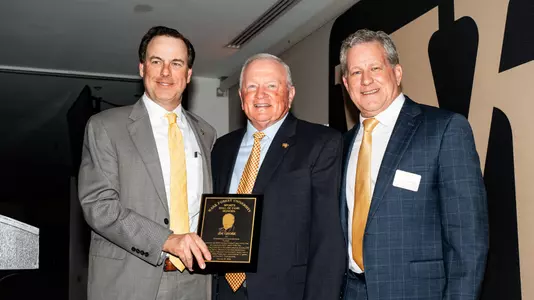
Jim Grobe’s Football Family Fuels Hall of Fame Run at Wake Forest
4/24/2026 11:35:00 AM | Football
Jim Grobe didn't spend much time at the podium in late February talking about wins and losses. He mentioned a few — the comeback at Chapel Hill, the Chip Vaughn block, the Jon Abbate interception — but mostly he talked about his wife Holly, his two sons, his grandchildren and the players who never started a game but came to practice every single day because they loved football.
That–more than the 77 victories or the ACC Championship or the five bowl appearances–is the thread that runs through the Grobe era at Wake Forest. And it's the thread he pulled on when he was inducted into the Wake Forest Sports Hall of Fame earlier this year.
"I was truly, truly carried here by my Wake Forest football family," Grobe said at the Hall of Fame induction ceremony in late February. "God bless and Go Deacs."
The numbers, of course, deserve their moment. When Grobe arrived in Winston-Salem in 2001, he inherited a program that had won four games the previous season and was in search of sustained success.
Over the next 13 years, which is the second-longest tenure in program history, he matched the school record for career coaching victories, tripled the previous program high for ACC wins and built Wake Forest into a program that belonged in the conversation at the top of its division.
The peak came in 2006. Wake Forest won a school-record 11 games while going a perfect 6-0 on the road. The Deacs claimed the ACC Atlantic Division title and defeated Georgia Tech 9-6 in the ACC Championship Game.
It was the program's second conference title ever and its first since 1970. It remains the only ACC football championship won by a North Carolina school in the 21st century, and the first by any NC school since Duke in 1989.
The national coaching community took notice. Grobe was named National Coach of the Year by the American Football Coaches Association, the Bobby Dodd Foundation, the Associated Press, The Sporting News and CBSSports.com. He was unanimously selected as ACC Coach of the Year earning all 80 votes from the league's media while becoming the sixth Wake Forest coach to earn that distinction.
The Deacs followed it with a 9-4 season in 2007 and an 8-5 mark in 2008, playing in three consecutive bowl games for the first time in school history. That three-year stretch (28-12) remains the standard against which every subsequent Wake Forest era has been measured.
The roster Grobe built during those years reads like a walk through the Wake Forest record books. Quarterback Riley Skinner became the program's second all-time leading passer. Chris Barclay finished as the all-time leading rusher. Alphonso Smith set the Wake Forest and ACC career interceptions record. Michael Campanaro became the program's all-time receptions leader. Offensive linemen Steve Vallos and Steve Justice were consensus All-Americans in 2006 and 2007, respectively.
But Grobe, speaking at the ceremony, was more intent on honoring a different group entirely.
"Many of our players were in my Hall of Fame," he said. "They may not be in the Wake Forest Hall of Fame, but they're in my Hall of Fame. These are guys who were mainly backups, or guys who were non-scholarship players that gave us a chance to compete every week. The only reason they played was they loved the game."
It was a recurring theme throughout his remarks — the idea that the best teams he coached weren't defined by the players who made All-ACC, but by the ones who never would. The walk-ons. The scout-teamers. The guys who showed up in the weight room in January and the practice field in August and asked for nothing in return but a chance to compete.
"Our best teams were made up of guys committed to each other, guys who played simply for the love of the game," he said. "The best thing about our best teams — you didn't have to push them into the fight. You had to pull them back out of it."
Grobe was equally generous in crediting those who made his arrival at Wake Forest possible in the first place. He thanked former athletic director Ron Wellman for giving him the opportunity, and gave an extended acknowledgement to Mike Hamrick — who had played for Grobe at Marshall and later served as athletic director at East Carolina — for putting in a word on his behalf.
"He pushed me on Ron," Grobe said with a smile. "He was probably not too happy when we opened with a win over his East Carolina Pirates."
He credited Jim Caldwell, his predecessor at Wake Forest, for leaving behind a roster loaded with talent that allowed the program to compete immediately. And he credited his coaching staff for developing players who might not have been the biggest or fastest, but were conditioned and fundamentally sound enough to win games in the fourth quarter.
"We ran and we ran and we ran," he said. "Our toughness and our conditioning gave us an edge, especially in the fourth quarter."
Before all of it — before the records, the championships, the accolades — Grobe made sure to acknowledge the people sitting in the room who had nothing to do with football and everything to do with why he was standing at the podium.
"My number one reason for being here is my family," he said. "They've always been the driving force behind my career."
He introduced his wife Holly as "my boss, my head coach, who knows a lot of football," along with sons Matt and Ben, grandchildren and in-laws and nieces and nephews. He noted, without a trace of irony, that no group of people in the building were bigger Wake Forest fans.
Grobe came to Wake Forest from Ohio, where he had spent six seasons rebuilding another struggling program from scratch. He left Winston-Salem in December 2013, resurfaced briefly at Baylor in 2016 to help stabilize a program in crisis, and then stepped away from coaching for good. He was 73 years old when he accepted the Hall of Fame honor in February.
The career numbers will outlast everyone in that room. But the way Grobe talked about his time at Wake Forest — the gratitude, the warmth, the insistence that the real story was the guys nobody remembers — said more about who he is than any record book ever could.
"I was blessed," he said. "I had great players. Not always the biggest, fastest or strongest. But I had guys that absolutely loved to play the game."
That–more than the 77 victories or the ACC Championship or the five bowl appearances–is the thread that runs through the Grobe era at Wake Forest. And it's the thread he pulled on when he was inducted into the Wake Forest Sports Hall of Fame earlier this year.
"I was truly, truly carried here by my Wake Forest football family," Grobe said at the Hall of Fame induction ceremony in late February. "God bless and Go Deacs."
The numbers, of course, deserve their moment. When Grobe arrived in Winston-Salem in 2001, he inherited a program that had won four games the previous season and was in search of sustained success.
Over the next 13 years, which is the second-longest tenure in program history, he matched the school record for career coaching victories, tripled the previous program high for ACC wins and built Wake Forest into a program that belonged in the conversation at the top of its division.
The peak came in 2006. Wake Forest won a school-record 11 games while going a perfect 6-0 on the road. The Deacs claimed the ACC Atlantic Division title and defeated Georgia Tech 9-6 in the ACC Championship Game.
It was the program's second conference title ever and its first since 1970. It remains the only ACC football championship won by a North Carolina school in the 21st century, and the first by any NC school since Duke in 1989.
The national coaching community took notice. Grobe was named National Coach of the Year by the American Football Coaches Association, the Bobby Dodd Foundation, the Associated Press, The Sporting News and CBSSports.com. He was unanimously selected as ACC Coach of the Year earning all 80 votes from the league's media while becoming the sixth Wake Forest coach to earn that distinction.
The Deacs followed it with a 9-4 season in 2007 and an 8-5 mark in 2008, playing in three consecutive bowl games for the first time in school history. That three-year stretch (28-12) remains the standard against which every subsequent Wake Forest era has been measured.
The roster Grobe built during those years reads like a walk through the Wake Forest record books. Quarterback Riley Skinner became the program's second all-time leading passer. Chris Barclay finished as the all-time leading rusher. Alphonso Smith set the Wake Forest and ACC career interceptions record. Michael Campanaro became the program's all-time receptions leader. Offensive linemen Steve Vallos and Steve Justice were consensus All-Americans in 2006 and 2007, respectively.
But Grobe, speaking at the ceremony, was more intent on honoring a different group entirely.
"Many of our players were in my Hall of Fame," he said. "They may not be in the Wake Forest Hall of Fame, but they're in my Hall of Fame. These are guys who were mainly backups, or guys who were non-scholarship players that gave us a chance to compete every week. The only reason they played was they loved the game."
It was a recurring theme throughout his remarks — the idea that the best teams he coached weren't defined by the players who made All-ACC, but by the ones who never would. The walk-ons. The scout-teamers. The guys who showed up in the weight room in January and the practice field in August and asked for nothing in return but a chance to compete.
"Our best teams were made up of guys committed to each other, guys who played simply for the love of the game," he said. "The best thing about our best teams — you didn't have to push them into the fight. You had to pull them back out of it."
Grobe was equally generous in crediting those who made his arrival at Wake Forest possible in the first place. He thanked former athletic director Ron Wellman for giving him the opportunity, and gave an extended acknowledgement to Mike Hamrick — who had played for Grobe at Marshall and later served as athletic director at East Carolina — for putting in a word on his behalf.
"He pushed me on Ron," Grobe said with a smile. "He was probably not too happy when we opened with a win over his East Carolina Pirates."
He credited Jim Caldwell, his predecessor at Wake Forest, for leaving behind a roster loaded with talent that allowed the program to compete immediately. And he credited his coaching staff for developing players who might not have been the biggest or fastest, but were conditioned and fundamentally sound enough to win games in the fourth quarter.
"We ran and we ran and we ran," he said. "Our toughness and our conditioning gave us an edge, especially in the fourth quarter."
Before all of it — before the records, the championships, the accolades — Grobe made sure to acknowledge the people sitting in the room who had nothing to do with football and everything to do with why he was standing at the podium.
"My number one reason for being here is my family," he said. "They've always been the driving force behind my career."
He introduced his wife Holly as "my boss, my head coach, who knows a lot of football," along with sons Matt and Ben, grandchildren and in-laws and nieces and nephews. He noted, without a trace of irony, that no group of people in the building were bigger Wake Forest fans.
Grobe came to Wake Forest from Ohio, where he had spent six seasons rebuilding another struggling program from scratch. He left Winston-Salem in December 2013, resurfaced briefly at Baylor in 2016 to help stabilize a program in crisis, and then stepped away from coaching for good. He was 73 years old when he accepted the Hall of Fame honor in February.
The career numbers will outlast everyone in that room. But the way Grobe talked about his time at Wake Forest — the gratitude, the warmth, the insistence that the real story was the guys nobody remembers — said more about who he is than any record book ever could.
"I was blessed," he said. "I had great players. Not always the biggest, fastest or strongest. But I had guys that absolutely loved to play the game."

Wednesday, August 19
Tuesday, August 18
Tuesday, August 18
Tuesday, August 18