Wake Forest Athletics
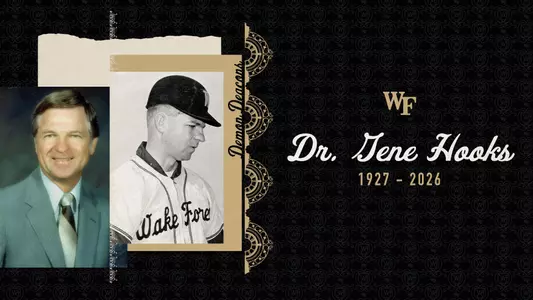
A Legacy Remembered: Dr. Gene Hooks Left Immeasurable Impact on Wake Forest University
4/7/2026 12:01:00 PM | Baseball, Cross Country, Field Hockey, Football, General, Men's Basketball, Men's Cross Country, Men's Golf, Men's Soccer, Men's Tennis, Men's Track and Field, Track and Field, Women's Basketball, Women's Cross Country, Women's Golf, Women's Soccer, Women's Tennis, Women's Track and Field, Women's Volleyball, Student Services, Spirit Program (Cheer/Dance/Mascot), Les Johns, Gold Rush
A Wake Forester in the truest sense, Dr. Gene Hooks attended the college in its original home of Wake Forest, N.C. He gained All-America honors as a third baseman in both 1949 and 1950 for the Deacon baseball squad, and he served as Director of Athletics at Wake Forest from 1964-1992.
WINSTON-SALEM, N.C. – Few individuals have impacted the trajectory of Wake Forest athletics as deeply as Dr. G. Eugene Hooks. As a baseball player, Hooks was an All-American for the Demon Deacons, but it was his leadership through 36 years as an administrator (28 as director of athletics) that made Hooks a Wake Forest Hall of Famer and Medallion of Merit winner, as well as a significant figure in the history of the Atlantic Coast Conference. Hooks died on April 6, 2026, at the age of 98.
Hooks began his athletic journey as a three-sport athlete at Rocky Mount High School. After enrolling at Wake Forest College, Hooks was named an All-American third baseman in 1949 and 1950 and helped the Deacs to a runner-up finish in the 1949 College World Series. En route to the championship, he was named to the All-Tournament team. He was a career .335 hitter for Wake Forest. In 2025, Dr. Hooks was inducted into the College Baseball Hall of Fame.
After graduation, Hooks signed with the Chicago Cubs and played pro baseball for five years before returning to work on his postgraduate degree in physical education from Wake Forest. He went on to earn his master's degree from the University of North Carolina in 1952 and served as an instructor in Physical Education at N.C. State. He also earned his doctorate in education and physical education from George Peabody College.
Hooks returned to Wake Forest in 1956 as a PE instructor and baseball coach. He was the head baseball coach for three years before returning to the classroom as a professor. In 1962, he wrote a book called Application of Weight Training in Athletics, and in 1964, he became the Athletic Director and earned a reputation as an innovator in promotions.
He oversaw the construction of many of the athletics facilities. Under his guidance, capital improvements included the construction of Allegacy Federal Credit Union Stadium, Lawrence Joel Veterans Memorial Coliseum, Leighton Tennis Stadium, the Arnold Palmer Golf Complex, sports medicine clinic, Manchester Athletic Center and the creation of the Wake Forest Sports Hall of Fame. He was a sound financial manager, with athletic department revenues increasing more than tenfold under his tenure. Wake Forest recognized Hooks' lifelong commitment to its athletic program by naming the baseball stadium after him in 1988. The Deacons won three national championships and 21 ACC titles during his tenure.
Hooks retired from Wake Forest in the summer of 1992 and received the Medallion of Merit, the highest award presented by Wake Forest, for distinguished service in 1993. In his first year of eligibility, Hooks was inducted into the Wake Forest Sports Hall of Fame for his work in elevating Wake Forest Athletics. He became the first executive director of the Division I-A Athletic Directors Association and served in that role until 1997. He also became one of the founders of the Great Eight Basketball Festival and was inducted into the North Carolina Sports Hall of Fame in 1999.
In July of 2021, Wake Forest Athletics announced the Robert Grant and Kenneth "Butch" Henry Trailblazer Award. Grant and Henry were the first Black football student-athletes to enroll at a Division I institution in the South, joining Wake Forest in the fall of 1964. Both Grant and Henry credit Dr. Hooks and then-Wake Forest President Harold Tribble with integrating intercollegiate athletics and enabling them to fulfill their dreams. Grant recalled their actions:
"Can you imagine the courage it took for Dr. Tribble, the president of the school at that time, along with Gene Hooks, who was the new athletics director, with Coach Bill Tate, in the South? At that time? In 1964? You never hear those three white men's names mentioned in regards to advances in Civil Rights during that era in the United States. You never even hear their names associated with it, but look at what they did. They made the decision. The courage it took for them as white men during that era; it's something that should be mentioned. Nobody else would do it. The people who were making threats at that time had demonstrated that they would follow through."
Hooks leaves behind his three sons (David, Dennis and Michael) from his first wife, Jean, along with his second wife, Sara '60, and her two sons (Frank '87 and Mark Johnson MBA '89).
Gene Hooks Lifetime Achievement Award
In 2007, in honor of Dr. Hooks, Wake Forest created the inaugural Gene Hooks Lifetime Achievement Award. The award recognizes a former Wake Forest athlete, manager, coach or administrator who has exhibited traits of integrity, charity and leadership and embodies the Pro Humanitate spirit that Dr. Gene Hooks demonstrated over his 45 years associated with Wake Forest.
Nominations for each award can be nominated by fans and will be selected by Wake Forest Athletics staff.
Past Gene Hooks Lifetime Achievement Award Recipients
On what Wake Forest was like when he arrived in 1946…
Hooks: Well, not anything like it is today, as I'm sure you know it was a little place in the woods. Really, since I know more about the Athletic Department than anything else, I'll just talk about the Athletic Department back then. I was recruited to play baseball, and came there in 1946 after I got out of the Navy. Most of all the players on our team were veterans of either the Army, Navy, or Marine Corps so forth. The average age of our team the first year was probably 23-24, because some of the guys there were 25 and 30, who had been in the service for five or six years. Facilities were not very good. The old gymnasium we used to dress down there was like a dungeon, very much like the other places we used to play. People today would have a hard time now relating to those kinds of facilities. Baseball field was a nice field; it was adjacent to the football practice area. We would hit balls down onto the football practice area, and everybody would be afraid to go get them because they might be embarrassed if they went down there to go get them. [Laughing] But it was a really friendly warm place, as you've heard you knew most of the people there. You knew your professors well, and I'll never forget the first English class that I went into at the Old Wake Forest. My professor was a really young guy that had just gotten there to be a professor, just the same time as I had gotten there as a student, Ed Wilson. As I would come away from class after the first couple of days, I used to think that he was the most wonderful professor I've ever, ever had. I used to be spellbound, and I never dreamed that the first professor that I would ever have would end up being the best professor that I ever had after going to three colleges, and getting a masters and a doctorate and he still was the best professor that I ever had, I was very fortunate in that respect. We all ate at the Colonial Club, it was sort of a buffet style meal, you sat down at a table and I remember at dinners, they always had a quart of milk at each place. Everybody was served on big plates, and the football players would take food and dump it onto one of their plates, and give their plates back to the waiter so that they could go back and get more before it all gave out. It was a good atmosphere, really, really good. It was a good group of people.
How veterans handled the rules of college…
Hooks: What rules? [Laughing] They were treated differently, you know people back then, and the school was like all schools after the service. They could not handle all the people, they were rooming people everywhere. My second year there, I slept in a basement, with about eight other students. In double decker beds, it was one bathroom for the eight of us. It was almost primitive back then, we were just crowded in and we made the best of it.
I had never been on a college campus before I went to Wake Forest, and I thought Wake Forest was just as good as, and very similar to all the others. And most of us hadn't. I was the first one in my family that had ever been to college, and I suspect that most of the people who were on our teams were on scholarship and on GI Bills so they probably wouldn't have ever gone to school otherwise, they'd never gone to school had it not been for the GI Bill of baseball scholarships, or what have you. We were happy because we felt like we were getting a very good break and college education. None of us had ever expected that we'd go, or even get a college education.
On playing baseball in those days…
Hooks: Well, for one thing we played twenty-five games. We couldn't start before March. And usually we didn't start practicing until March. We would play the first game around the middle of March. We had good equipment. The New York Yankees provided it. Most of our equipment was provided by them, most of the schools had working relationships. We were with the Yankees, Carolina was with the Red Sox, NC State was with the Detroit Tigers, Duke had Jake Combs, but I'm not sure which major league team he had a relationship with. They [MLB teams] provided the equipment, as well as money for scholarships and so forth. I told you previously that I was recruited by P. Head Walker, who had been a minor league baseball player, and who was a scout for the New York Yankees and I think that very few people know that. He was a very astute baseball man and he would come to our games, and he was very much into our sport. But we would play not just college teams, but minor league teams too back during that time. We would play our semi-pro teams, and we were in the southern conference, and we would certainly not go up to play Richmond, VMI, VPI, and schools like that, but we would basically play Big Four games, minor league teams, and Elon and some of the smaller schools.
On his life after graduation in 1950…
Hooks: Well, I signed a professional baseball contract and back then the maximum you could sign without being put on a major league roster was for $8,000. And I had ten or twelve teams that offered me the same thing, except Brooklyn offered me $20,000 and would put me on a major league roster. Well, I was foolish enough to think that I didn't want to go to Brooklyn. I had never been a Brooklyn fan and for some stupid reason I didn't take it. But I signed with the Chicago Cubs, one of the biggest mistakes of my life because they were not a very good organization and didn't spend a lot on their players and if you got hurt you still had to play because they didn't have enough players on the team and so forth. So what I did was play five years of minor league baseball. I hurt my arm the fifth year and was not able to play anymore. I went to Carolina to get my master's, they were on a quarter system so I'd go to winter quarters and fellowship over there. My roommate was Tom Fetcher, and his uncle was Coach Bob Fetcher, who was the Athletic Director at Carolina, and he placed us as long as fellowship was concerned. Tom and I went to Carolina to get our master's and then we would go two quarters and then go play baseball and then go back two quarters. I got my master's and then I went back for a little beyond that to Peabody out in Nashville, pretty much under the same arrangement until finally in 1955 I had to put in a year's residence and I got my doctorate at Peabody. Then the job at Wake Forest became open for the baseball coach and I came to Wake Forest in 1956, the first year on the new campus as the baseball coach, and as assistant professor of physical education.
On how he became the Athletics Director in 1964…
Hooks: That was in 1964. I had a really interesting career when I was in physical education. I wrote my dissertation on a study on the relationship between the baseball skills of hitting, running, and throwing and strength and lever-length and did a statistical study on quite a few of our physical education students. And found that lever-length had little to do with it, but found that strength had a lot to do with baseball skills of hitting, running, and throwing. It was a high correlation. So, I started doing so experimenting with strength development and power development and I am probably telling you a little bit more that you want to hear about this but I did so before and after testing with those and found out that I was making a difference and so I started doing a lot of work with weight training and weight lifting. Trying to develop exercises that related to various types of movements such as swinging a golf club or baseball bat or doing blocking in football or throwing a football and tackling what have you and developed exercise for those different sports using weights far before it was the acceptable thing to do because people were scared that lifting weights would make your muscle bound up. I did enough of it to be convinced in my own mind that it was good and wrote a book on it. In fact, Prentice Hall published it and it turned out to be very popular. It was done in Russian and in Japanese, and in US English, and actually it was more popular in Russian then it was anywhere else. But I became involved in teaching anatomy and kinesiology and physiology and developed a really close relationship with the people at Baptist Hospital and Dr. Pritedge, who was my next door neighbor. He was a pathologist, so I really got into that. I would start all of that kind of work at Wake Forest and in the physical education department, and that was what I was doing when the change came in the athletic directorship at Wake Forest. For some reason Bonus thought I would make a good Athletic Director. My office was next to his, we would talk about it some but I had no interest at all in being an Athletic Director and when they asked me to do it, my wife was still shaking her head because at that time I was at full professorship in the physical education had a summer camp for kids. I was a full time scout for North Carolina and South Carolina for the Houston Colt 45's as they were known at that time, and I officiated football for the Atlantic Coast Conference. I was just enjoying life and doing things that were nice income producers, as well as things that I enjoyed doing. I had to give all that up when I became Athletic Director, and had a reduced salary [Laughing] in 1964.
On his relationship with then-University President Dr. Tribble…
Hooks: It grew to be a very good one in a short period of time. I tell one story that probably changed our relationship quite a bit, because I didn't know anything about being an Athletic Director, I didn't know what I was supposed to do. There was nobody to train you, you just learned by trying things. I will never forget when I went into that office I would come up with such a bright idea, and Skeeter and Jesse were there [Laughing] and they would just look at me and say 'we have tried that a thousand times you can't do that.' Well, I would say you gotta try, we have to try things, and so we would give it a lot of effort. Over the years I have tried things that nobody else has done since. Some of them turned out to be very bad ideas but occasionally we would have a good idea along the way.
On how and when the ACC Men's Basketball Tournament became the event in college basketball…
Hooks: I don't know, but pretty soon after the formulation of the conference. It was not an event when it was back in the Southern Conference and done in Raleigh and so forth. Once the conference was formed and we started playing Dickie Hemric and that group started playing and their teams started playing and the eight teams started playing each other twice a year, it grew pretty quickly, but I can't remember.
It was initially held in Reynolds Coliseum, and then it moved to Greensboro.
Hooks: Yeah. Reynolds on the basis of the Dixie Classic. They sold those tickets and had full houses and so forth, but it didn't take long before the coaches got the Athletics Directors to understand that none of the other teams could grow and build their programs as long as it was at one of the school's sites.
On his life and memories of Wake Forest...
Hooks: I have a lot of good memories and a lot of heartache. When you have all three of your kids grow up on a Wake Forest campus and they went to other schools, Wake Forest is their school and they like it. Every time Wake Forest wins a basketball game we get a telephone call and everyone wants to talk about it. They know all about all the teams and the grandchildren are the same way. Wake Forest has come a long way. It has elevated its image so much in the years since we have been in Winston-Salem. I loved old Wake Forest, but we just didn't have the chance of being athletics or whether it being academics like Chemistry, Physics, or the Arts. We just didn't have that chance to grow. I think that Wake Forest has had a tremendous impact on Winston-Salem. Look at the three presidents that I worked under, I don't think that anyone could have moved Wake Forest like Harold Tribble did. Nobody else would have the vision or thick skin so that they could handle all of the criticism. We have gone down to Eastern Carolina and people have not done anything but want to criticize what we have done in Winston-Salem. When we recruited the first black athlete, Bill Tate and I went down to a meeting in Wilmington, NC, a Deacon Club meeting, and they wrote an article. Then we went down to Raleigh another night and they wrote an article about us recruiting black athletes. They questioned us about why we were recruiting black athletes because nobody else was, so we told them we were going to have fun because we were the only ones that were recruiting black athletes. They put that in the paper, and then we went to that Wilmington Deacon Club meeting and not a soul was there. Not even the person that was supposed to be hosting us, and then we went to Roanoke Rapids and the guy, who was mayor of the town, a Wake Forest guy, and an old fraternity brother of mine, we had quite a turn out there, and we almost got through the program and nobody said anything about it [the news article]. Then I said, "If there are no more questions I will call it a night." The guy who was the mayor of Roanoke Rapids said, "Hooker, I hope you don't think you gone get by without saying anything about those blacks at Wake Forest?" That was pretty much the way that they felt. So, we have come a long way from those days. It is hard for anybody in this day and age to really relate to some of the things that we went through during those days. But, Wake Forest has grown in stature, and has grown in class, and just has grown in so many ways. Dr. Tribble was responsible for moving it, and Dr. Scales was a wonderful human being who took us through some of the roughest days as far as sit-ins and student revolts and the Baptists and the dancing. Just one crisis after another. The truth of the matter is, that nobody can come close to imagining how much that hurt us, as far as football, basketball, and athletic recruiting is concerned. The annual fire at the annual Baptist convention was just out right embarrassing, but he got us through that period of time. I will never forget the night that we went to Bowman Gray Stadium during the race riots and had to have the National Guard all along US Highway 52, stationed there so we could get the team buses through the campus over there to play the University of South Carolina that night. The mayor and John Gold were just determined that they were not going to let them call the game off. Dr. Hearn came in and ran it like a business and it was the first time that it had been done that way. They didn't have a lot of expertise in the arts and in all those things academically important. He also had a lot of feel to run the school like a business and with making sure that it continued to grow all the programs which included athletics. I don't know that the last year I was athletic director in 1992; we were able to operate alone without any supplement from the school. But with Title IX, we wouldn't have been able to continue to support athletics. They went from 1964 to 1992 without having to spend any money on athletics, and we did our own facilities and our own pay, utilities, and everything associated with athletics. We were able to generate the revenue whether it be through donations or through gift receipts from television to pay for all of it.
Hooks began his athletic journey as a three-sport athlete at Rocky Mount High School. After enrolling at Wake Forest College, Hooks was named an All-American third baseman in 1949 and 1950 and helped the Deacs to a runner-up finish in the 1949 College World Series. En route to the championship, he was named to the All-Tournament team. He was a career .335 hitter for Wake Forest. In 2025, Dr. Hooks was inducted into the College Baseball Hall of Fame.
After graduation, Hooks signed with the Chicago Cubs and played pro baseball for five years before returning to work on his postgraduate degree in physical education from Wake Forest. He went on to earn his master's degree from the University of North Carolina in 1952 and served as an instructor in Physical Education at N.C. State. He also earned his doctorate in education and physical education from George Peabody College.
Hooks returned to Wake Forest in 1956 as a PE instructor and baseball coach. He was the head baseball coach for three years before returning to the classroom as a professor. In 1962, he wrote a book called Application of Weight Training in Athletics, and in 1964, he became the Athletic Director and earned a reputation as an innovator in promotions.
He oversaw the construction of many of the athletics facilities. Under his guidance, capital improvements included the construction of Allegacy Federal Credit Union Stadium, Lawrence Joel Veterans Memorial Coliseum, Leighton Tennis Stadium, the Arnold Palmer Golf Complex, sports medicine clinic, Manchester Athletic Center and the creation of the Wake Forest Sports Hall of Fame. He was a sound financial manager, with athletic department revenues increasing more than tenfold under his tenure. Wake Forest recognized Hooks' lifelong commitment to its athletic program by naming the baseball stadium after him in 1988. The Deacons won three national championships and 21 ACC titles during his tenure.
Hooks retired from Wake Forest in the summer of 1992 and received the Medallion of Merit, the highest award presented by Wake Forest, for distinguished service in 1993. In his first year of eligibility, Hooks was inducted into the Wake Forest Sports Hall of Fame for his work in elevating Wake Forest Athletics. He became the first executive director of the Division I-A Athletic Directors Association and served in that role until 1997. He also became one of the founders of the Great Eight Basketball Festival and was inducted into the North Carolina Sports Hall of Fame in 1999.
In July of 2021, Wake Forest Athletics announced the Robert Grant and Kenneth "Butch" Henry Trailblazer Award. Grant and Henry were the first Black football student-athletes to enroll at a Division I institution in the South, joining Wake Forest in the fall of 1964. Both Grant and Henry credit Dr. Hooks and then-Wake Forest President Harold Tribble with integrating intercollegiate athletics and enabling them to fulfill their dreams. Grant recalled their actions:
"Can you imagine the courage it took for Dr. Tribble, the president of the school at that time, along with Gene Hooks, who was the new athletics director, with Coach Bill Tate, in the South? At that time? In 1964? You never hear those three white men's names mentioned in regards to advances in Civil Rights during that era in the United States. You never even hear their names associated with it, but look at what they did. They made the decision. The courage it took for them as white men during that era; it's something that should be mentioned. Nobody else would do it. The people who were making threats at that time had demonstrated that they would follow through."
Hooks leaves behind his three sons (David, Dennis and Michael) from his first wife, Jean, along with his second wife, Sara '60, and her two sons (Frank '87 and Mark Johnson MBA '89).
Gene Hooks Lifetime Achievement Award
In 2007, in honor of Dr. Hooks, Wake Forest created the inaugural Gene Hooks Lifetime Achievement Award. The award recognizes a former Wake Forest athlete, manager, coach or administrator who has exhibited traits of integrity, charity and leadership and embodies the Pro Humanitate spirit that Dr. Gene Hooks demonstrated over his 45 years associated with Wake Forest.
Nominations for each award can be nominated by fans and will be selected by Wake Forest Athletics staff.
Past Gene Hooks Lifetime Achievement Award Recipients
- 2025 - Dr. Caryl Guth, Wake Forest Philanthropist
- 2024 - Lynne Heflin, Former Men's Basketball Administrative Assistant
- 2023 – Syd Kitson ('80), Football
- 2021 - Barbara Trautwein, Former Bands Manager
- 2019 – John Foster ('78), Former Football Manager
- 2018 – Judge Albert Kirby ('80), Football
- 2017 – Tal Jobe ('67), Men's Basketball
- 2016 – Cook Griffin ('65, P '00), Former Football Manager
- 2015 – Dr. Stephanie Glenn ('77, M.D. '81), Volleyball
- 2014 – Abe Elmore ('55), Former Football Manager
- 2013 – Julie Griffin ('69, P '00), Cheerleader
- 2012 – Bill Faircloth ('64, P '89, P '90, P '93, P '94, GP '19, GP '22, GP '24), Football
- 2011 – Jim Turner ('55), Football
- 2010 – Chip Rives ('87, M.B.A. '89), Football
- 2009 – Jesse Haddock ('52, P '68, GP '97, GP '99*, GP '03), Former Head Men's Golf Coach
- 2008 – Bob McCreary ('61), Football
- 2007 – Dr. Gene Hooks ('50, P '81), Baseball
- Former Wake Forest Director of Athletics Ron Wellman:
- "Dr. Gene Hooks devoted his entire life to Wake Forest. He was an All-American baseball player, coached the baseball team, and served as our Athletics Director for 27 years. He loved his Demon Deacons. He attended football, basketball and baseball games right up to his passing. Wake Forest was able to stay in the ACC when we didn't have the facilities or resources that other ACC schools had because of Gene. He wouldn't consider leaving the ACC when others didn't believe we should stay. He was respected nationally for all that he accomplished while leading our program. He was a good friend who I will miss."
- ACC Commissioner Jim Phillips, Ph.D.:
- "Dr. Gene Hooks was a transformational leader for both Wake Forest and the Atlantic Coast Conference. His steadfast loyalty and dedication throughout his days as a student-athlete, coach and Athletics Director and in his retirement were remarkable. Our hearts will remain with his family and the entire Demon Deacon community."
- Former ACC Commissioner and UNC Athletics Director John Swofford:
- "Dr. Gene Hooks was a man of great values who always led with integrity. We were both former student-athletes that went on to serve at our alma maters. During our 12 years together serving as Athletics Directors in the ACC, we always appreciated how unique and special that was and how it brought us together. Gene will be remembered as a gentleman who made significant contributions to both Wake Forest and the ACC."
- Former President and Chief Executive Officer of the LEAD1 Association Tom McMillen:
- "Gene Hooks was one of the longest tenured athletics directors in the history of intercollegiate athletics and led our association (formerly the Division I-A Athletic Directors Association) as Executive Director for several years. In doing so, Gene helped lay the foundation for our organization today and I am so grateful for all his contributions. He will be dearly missed by all in the LEAD1 community. It is a very sad day for intercollegiate athletics."
- Ben Sutton ('80, '83):
- "More than anyone else, Dr. Gene Hooks helped shape my professional development and leadership style. He really valued character, hard work, curiosity and creativity. His influence on the way college sports media rights were packaged and sold was profound. He was extraordinarily instrumental in the creation of our first company, ISP Sports. And, his leadership at the most critical junctures in the history of the Atlantic Coast Conference was enormous. He is literally one of the most revered figures in the league. Gene has not only been an incredible mentor, partner and friend to me for more than 40 years, but a strong influence on the thousands of student-athletes' lives he touched over his decades of service to Wake Forest and college sports."
- President Susan R. Wente, Ph.D.:
- "One of the hallmarks of Wake Forest is its tradition of developing student-athletes who succeed in their sports as well as in the classroom. While many people have contributed to this culture, Dr. Gene Hooks laid its foundation. His incredible dedication to Wake Forest University and to Demon Deacon athletics is an inspiration for us all, and leaves a powerful legacy."
- Vice President & Director of Athletics John Currie ('93):
- "Dr. Gene Hooks is a mentor, friend and leader and someone that left an indelible impact on Wake Forest University. From his stellar playing days as an All-American baseball player, to his foresight and leadership to integrate Wake Forest Athletics with President Harold Tribble and his ongoing efforts to promote women's athletics, Dr. Hooks was truly an advocate for all as he embodied the Pro Humanitate motto of our University. Not to be outdone, he did so much for the Atlantic Coast Conference and thousands of student-athletes to create opportunities and his impact is still felt today."
On what Wake Forest was like when he arrived in 1946…
Hooks: Well, not anything like it is today, as I'm sure you know it was a little place in the woods. Really, since I know more about the Athletic Department than anything else, I'll just talk about the Athletic Department back then. I was recruited to play baseball, and came there in 1946 after I got out of the Navy. Most of all the players on our team were veterans of either the Army, Navy, or Marine Corps so forth. The average age of our team the first year was probably 23-24, because some of the guys there were 25 and 30, who had been in the service for five or six years. Facilities were not very good. The old gymnasium we used to dress down there was like a dungeon, very much like the other places we used to play. People today would have a hard time now relating to those kinds of facilities. Baseball field was a nice field; it was adjacent to the football practice area. We would hit balls down onto the football practice area, and everybody would be afraid to go get them because they might be embarrassed if they went down there to go get them. [Laughing] But it was a really friendly warm place, as you've heard you knew most of the people there. You knew your professors well, and I'll never forget the first English class that I went into at the Old Wake Forest. My professor was a really young guy that had just gotten there to be a professor, just the same time as I had gotten there as a student, Ed Wilson. As I would come away from class after the first couple of days, I used to think that he was the most wonderful professor I've ever, ever had. I used to be spellbound, and I never dreamed that the first professor that I would ever have would end up being the best professor that I ever had after going to three colleges, and getting a masters and a doctorate and he still was the best professor that I ever had, I was very fortunate in that respect. We all ate at the Colonial Club, it was sort of a buffet style meal, you sat down at a table and I remember at dinners, they always had a quart of milk at each place. Everybody was served on big plates, and the football players would take food and dump it onto one of their plates, and give their plates back to the waiter so that they could go back and get more before it all gave out. It was a good atmosphere, really, really good. It was a good group of people.
How veterans handled the rules of college…
Hooks: What rules? [Laughing] They were treated differently, you know people back then, and the school was like all schools after the service. They could not handle all the people, they were rooming people everywhere. My second year there, I slept in a basement, with about eight other students. In double decker beds, it was one bathroom for the eight of us. It was almost primitive back then, we were just crowded in and we made the best of it.
I had never been on a college campus before I went to Wake Forest, and I thought Wake Forest was just as good as, and very similar to all the others. And most of us hadn't. I was the first one in my family that had ever been to college, and I suspect that most of the people who were on our teams were on scholarship and on GI Bills so they probably wouldn't have ever gone to school otherwise, they'd never gone to school had it not been for the GI Bill of baseball scholarships, or what have you. We were happy because we felt like we were getting a very good break and college education. None of us had ever expected that we'd go, or even get a college education.
On playing baseball in those days…
Hooks: Well, for one thing we played twenty-five games. We couldn't start before March. And usually we didn't start practicing until March. We would play the first game around the middle of March. We had good equipment. The New York Yankees provided it. Most of our equipment was provided by them, most of the schools had working relationships. We were with the Yankees, Carolina was with the Red Sox, NC State was with the Detroit Tigers, Duke had Jake Combs, but I'm not sure which major league team he had a relationship with. They [MLB teams] provided the equipment, as well as money for scholarships and so forth. I told you previously that I was recruited by P. Head Walker, who had been a minor league baseball player, and who was a scout for the New York Yankees and I think that very few people know that. He was a very astute baseball man and he would come to our games, and he was very much into our sport. But we would play not just college teams, but minor league teams too back during that time. We would play our semi-pro teams, and we were in the southern conference, and we would certainly not go up to play Richmond, VMI, VPI, and schools like that, but we would basically play Big Four games, minor league teams, and Elon and some of the smaller schools.
On his life after graduation in 1950…
Hooks: Well, I signed a professional baseball contract and back then the maximum you could sign without being put on a major league roster was for $8,000. And I had ten or twelve teams that offered me the same thing, except Brooklyn offered me $20,000 and would put me on a major league roster. Well, I was foolish enough to think that I didn't want to go to Brooklyn. I had never been a Brooklyn fan and for some stupid reason I didn't take it. But I signed with the Chicago Cubs, one of the biggest mistakes of my life because they were not a very good organization and didn't spend a lot on their players and if you got hurt you still had to play because they didn't have enough players on the team and so forth. So what I did was play five years of minor league baseball. I hurt my arm the fifth year and was not able to play anymore. I went to Carolina to get my master's, they were on a quarter system so I'd go to winter quarters and fellowship over there. My roommate was Tom Fetcher, and his uncle was Coach Bob Fetcher, who was the Athletic Director at Carolina, and he placed us as long as fellowship was concerned. Tom and I went to Carolina to get our master's and then we would go two quarters and then go play baseball and then go back two quarters. I got my master's and then I went back for a little beyond that to Peabody out in Nashville, pretty much under the same arrangement until finally in 1955 I had to put in a year's residence and I got my doctorate at Peabody. Then the job at Wake Forest became open for the baseball coach and I came to Wake Forest in 1956, the first year on the new campus as the baseball coach, and as assistant professor of physical education.
On how he became the Athletics Director in 1964…
Hooks: That was in 1964. I had a really interesting career when I was in physical education. I wrote my dissertation on a study on the relationship between the baseball skills of hitting, running, and throwing and strength and lever-length and did a statistical study on quite a few of our physical education students. And found that lever-length had little to do with it, but found that strength had a lot to do with baseball skills of hitting, running, and throwing. It was a high correlation. So, I started doing so experimenting with strength development and power development and I am probably telling you a little bit more that you want to hear about this but I did so before and after testing with those and found out that I was making a difference and so I started doing a lot of work with weight training and weight lifting. Trying to develop exercises that related to various types of movements such as swinging a golf club or baseball bat or doing blocking in football or throwing a football and tackling what have you and developed exercise for those different sports using weights far before it was the acceptable thing to do because people were scared that lifting weights would make your muscle bound up. I did enough of it to be convinced in my own mind that it was good and wrote a book on it. In fact, Prentice Hall published it and it turned out to be very popular. It was done in Russian and in Japanese, and in US English, and actually it was more popular in Russian then it was anywhere else. But I became involved in teaching anatomy and kinesiology and physiology and developed a really close relationship with the people at Baptist Hospital and Dr. Pritedge, who was my next door neighbor. He was a pathologist, so I really got into that. I would start all of that kind of work at Wake Forest and in the physical education department, and that was what I was doing when the change came in the athletic directorship at Wake Forest. For some reason Bonus thought I would make a good Athletic Director. My office was next to his, we would talk about it some but I had no interest at all in being an Athletic Director and when they asked me to do it, my wife was still shaking her head because at that time I was at full professorship in the physical education had a summer camp for kids. I was a full time scout for North Carolina and South Carolina for the Houston Colt 45's as they were known at that time, and I officiated football for the Atlantic Coast Conference. I was just enjoying life and doing things that were nice income producers, as well as things that I enjoyed doing. I had to give all that up when I became Athletic Director, and had a reduced salary [Laughing] in 1964.
On his relationship with then-University President Dr. Tribble…
Hooks: It grew to be a very good one in a short period of time. I tell one story that probably changed our relationship quite a bit, because I didn't know anything about being an Athletic Director, I didn't know what I was supposed to do. There was nobody to train you, you just learned by trying things. I will never forget when I went into that office I would come up with such a bright idea, and Skeeter and Jesse were there [Laughing] and they would just look at me and say 'we have tried that a thousand times you can't do that.' Well, I would say you gotta try, we have to try things, and so we would give it a lot of effort. Over the years I have tried things that nobody else has done since. Some of them turned out to be very bad ideas but occasionally we would have a good idea along the way.
On how and when the ACC Men's Basketball Tournament became the event in college basketball…
Hooks: I don't know, but pretty soon after the formulation of the conference. It was not an event when it was back in the Southern Conference and done in Raleigh and so forth. Once the conference was formed and we started playing Dickie Hemric and that group started playing and their teams started playing and the eight teams started playing each other twice a year, it grew pretty quickly, but I can't remember.
It was initially held in Reynolds Coliseum, and then it moved to Greensboro.
Hooks: Yeah. Reynolds on the basis of the Dixie Classic. They sold those tickets and had full houses and so forth, but it didn't take long before the coaches got the Athletics Directors to understand that none of the other teams could grow and build their programs as long as it was at one of the school's sites.
On his life and memories of Wake Forest...
Hooks: I have a lot of good memories and a lot of heartache. When you have all three of your kids grow up on a Wake Forest campus and they went to other schools, Wake Forest is their school and they like it. Every time Wake Forest wins a basketball game we get a telephone call and everyone wants to talk about it. They know all about all the teams and the grandchildren are the same way. Wake Forest has come a long way. It has elevated its image so much in the years since we have been in Winston-Salem. I loved old Wake Forest, but we just didn't have the chance of being athletics or whether it being academics like Chemistry, Physics, or the Arts. We just didn't have that chance to grow. I think that Wake Forest has had a tremendous impact on Winston-Salem. Look at the three presidents that I worked under, I don't think that anyone could have moved Wake Forest like Harold Tribble did. Nobody else would have the vision or thick skin so that they could handle all of the criticism. We have gone down to Eastern Carolina and people have not done anything but want to criticize what we have done in Winston-Salem. When we recruited the first black athlete, Bill Tate and I went down to a meeting in Wilmington, NC, a Deacon Club meeting, and they wrote an article. Then we went down to Raleigh another night and they wrote an article about us recruiting black athletes. They questioned us about why we were recruiting black athletes because nobody else was, so we told them we were going to have fun because we were the only ones that were recruiting black athletes. They put that in the paper, and then we went to that Wilmington Deacon Club meeting and not a soul was there. Not even the person that was supposed to be hosting us, and then we went to Roanoke Rapids and the guy, who was mayor of the town, a Wake Forest guy, and an old fraternity brother of mine, we had quite a turn out there, and we almost got through the program and nobody said anything about it [the news article]. Then I said, "If there are no more questions I will call it a night." The guy who was the mayor of Roanoke Rapids said, "Hooker, I hope you don't think you gone get by without saying anything about those blacks at Wake Forest?" That was pretty much the way that they felt. So, we have come a long way from those days. It is hard for anybody in this day and age to really relate to some of the things that we went through during those days. But, Wake Forest has grown in stature, and has grown in class, and just has grown in so many ways. Dr. Tribble was responsible for moving it, and Dr. Scales was a wonderful human being who took us through some of the roughest days as far as sit-ins and student revolts and the Baptists and the dancing. Just one crisis after another. The truth of the matter is, that nobody can come close to imagining how much that hurt us, as far as football, basketball, and athletic recruiting is concerned. The annual fire at the annual Baptist convention was just out right embarrassing, but he got us through that period of time. I will never forget the night that we went to Bowman Gray Stadium during the race riots and had to have the National Guard all along US Highway 52, stationed there so we could get the team buses through the campus over there to play the University of South Carolina that night. The mayor and John Gold were just determined that they were not going to let them call the game off. Dr. Hearn came in and ran it like a business and it was the first time that it had been done that way. They didn't have a lot of expertise in the arts and in all those things academically important. He also had a lot of feel to run the school like a business and with making sure that it continued to grow all the programs which included athletics. I don't know that the last year I was athletic director in 1992; we were able to operate alone without any supplement from the school. But with Title IX, we wouldn't have been able to continue to support athletics. They went from 1964 to 1992 without having to spend any money on athletics, and we did our own facilities and our own pay, utilities, and everything associated with athletics. We were able to generate the revenue whether it be through donations or through gift receipts from television to pay for all of it.

.jpg&height=340&type=webp)

Wednesday, October 07
Tuesday, October 06
Monday, October 05
Monday, October 05