Wake Forest Athletics
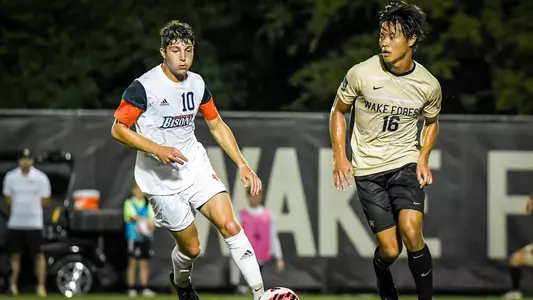
Deacon Sports Xtra: Adapt And Adjust
9/6/2021 9:00:00 AM | General, Men's Soccer
From Japan to Florida to Wake Forest, the Wake Forest sophomore has learned how to adapt to his environment.
For Hosei Kijima life has been about his ability to adapt to his environment.
There was the adjustment of moving from Japan to England briefly and back. There was the decision to move to the United States, alone, when he was 12 years old. There was enrolling at Wake Forest a semester early in 2020.
And then there’s the ability -- and capability -- to play and adjust to multiple roles on the field in a Wake Forest kit.
“My family was a very international family,” Kijima said. “My parents had a very open mind for me to learn about other cultures and other countries. I would go out to other countries by myself when I was like nine years old. The first time I went out was to England to the Manchester United soccer school for a one-month camp.
“It was a hard time, but I came back and my mom just kept searching for more camps for me to go to, and she found IMG Academy where I went for the past seven years. We thought about it for a little bit, it was a difficult decision, but in the end we said, ‘Why not try it?’ Eventually middle and high school went by and I got recruited by Wake Forest.”
It is not uncommon for incoming freshmen to Wake Forest’s nationally-prominent men’s soccer program to enroll a semester early, as have current professionals Brad Dunwell, Calvin Harris, Andrew Pannenberg and Isaiah Parente have done.
But the experience Kijima had was unlike any other in the program’s 41-year existence. The Yokohama, Japan, native had the opportunity to play in the team’s handful of games last spring before the pandemic sent the entire global community into a shutdown.
He could no longer remain on campus or train with his teammates.
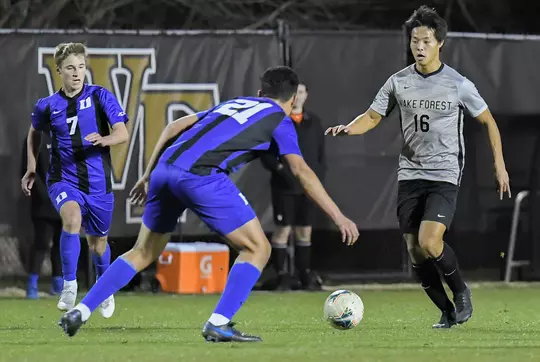
“The first couple of weeks I was here, it was hard even without Covid because of the transition from high school to college,” Kijima admitted. “It’s such a big step. The environment, the climate, on the field, the speed of play and the physicality. All those characteristics of college soccer and college itself. I don’t think you really ever get a top-25 school and a top-10 ranked soccer program together like you do here.”
With uncertainty on international travel restrictions, Kijima decided not to return to Japan but to head back to IMG Academy.
“It was difficult at first obviously, because a 12-year-old Japanese kid coming to the States by himself...there it is right there, that’s difficult,” Kijima recalled of originally attending IMG Academy. “I also was kind of crazy at the time, in terms of my behavior and stuff. I really didn’t know how to act, especially because it was a different culture, different language, different country. The first year I got here I had 27 detentions. I was a crazy boy, going around just like fighting people, not going to school--skipping it because I did not want to go.”
Eventually, though, Kijima adjusted.
“That was one of the biggest transitions in my life: becoming independent by myself,” he said. “Becoming independent with your parents is different, because they teach you how to come independent. But becoming independent with your own power, your own skill I think is something very different.”
Last fall, after returning to campus and resuming in-person training with his teammates, Kijima earned a start in his first collegiate appearance: a 3-1 victory over Louisville. But it was his lone start in the fall, as he took on a reserve role.
“I started off well in preseason, and I was playing well, but there’s high expectations in this program in terms of consistency in how you train and how you do everything,” Kijima said. “I didn’t understand that concept until right before the season ended, and it was difficult because I had never experienced that competition and that level of expectation.”
Kijima said that he tried to learn as much as he could from the veteran leaders on the team, all of whom would eventually sign professional contracts just months later.
“I was like a sponge,” he said. “I tried my best to take that information, because that means they were playing at a professional level here. I just had to rigorously learn how they were. I asked them about their routines, how they trained, how they prepared for games and training. On the field, too, I would ask questions doing my best to learn as much as possible.”
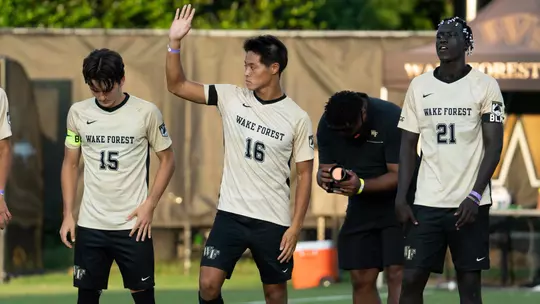
I did my best to get information from the guys playing pro right now like Isaiah Parente, Machop Chol, Andrew Pannenberg, even Joey DeZart. I tried my best to take that information, because that means they were playing at a professional level here.
In the spring, as he and his teammates were playing official contests for the first time in the months of March, April and May, Kijima experienced a breakthrough moment.
Hosting Boston College in an early March showdown, it looked as if Wake Forest was going to drop the ACC contest at Spry Stadium. Despite having nearly double the shots of the Eagles, the Demon Deacons were trailing 2-1 with the remaining minutes of the second half ticking away.
Then in the 85th minute, Kijima scored his first-career goal to tie the match. Less than four minutes later, he struck again, this time to give Wake Forest a thrilling 3-2 victory.
“I think one of the biggest motivations to play my best was the fact that we lost so many players to the MLS, and then also the thin roster with the freshmen not being able to play,” he said. “That left us with 14, 15 players that can actually play. I think I was one of the people that realized anything is possible and I have to be ready for the unexpected.
“That gave me confidence to play. The second goal that Boston College scored, it was kind of my fault, but it lit a fire up me. After the first goal, it gave me some confidence that I could play here. I realized if I do the right things, it's possible for me to play here. The two goals were spontaneous. I happened to be in the right place at the right time and I guess the rest is history.”
Kijima would go on to win the team’s Most Improved Player award, starting six of the remaining seven spring contests as the Demon Deacons would make a run to the Elight Eight of the NCAA Men’s Soccer Championship.
Now as a sophomore, he’s adapting and adjusting. Again.
“I’m bought into how we play, and once I understood the expectation of being consistent and not having mistakes all over the place, I think that’s one of my main goals this year is to maintain that level of consistency and perform on the field,” Kijima said. “Not for whenever we need it, but whenever I’m on the field. That was the mentality in the spring, but I think that has to change because we have personnel now, and there is competition.”
.jpg&height=340&type=webp)