Wake Forest Athletics
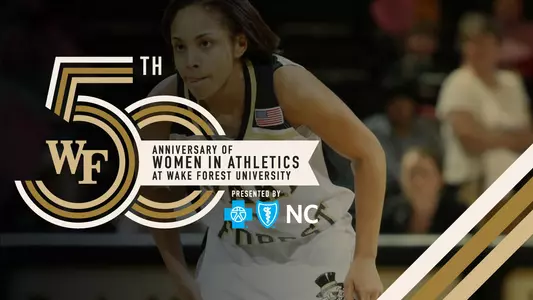
Deacon Sports Xtra: Wake Forest: A Place of Learning On and Off the Court for Jones
2/3/2022 10:16:00 AM | Women's Basketball, Les Johns
“With my grandmother being a school teacher, the concept of being able to go to Wake Forest for free and graduate was really impactful.” - Porsche Jones
Black History Month: Wake Forest Athletics will have many stories and content throughout Black History Month on GoDeacs.com and through all team social media accounts. Information and profiles shared are archived here.
It's a good thing Porsche Jones fine-tuned her time management skills during her standout basketball career at Wake Forest. In addition to a full-time job at Norvant Custody, Jones recently opened the BOND (Building on New Development) Center of Excellence, a community center in Winston-Salem that offers basketball courts, weight rooms and fitness areas, as well as classroom areas. Two years ago, she purchased a company that deals with real estate and investments.
"I'm pretty much here, there and everywhere," Jones jokes. "Always busy."
And then there's her dump trucking.
Along with former Carver high school teacher and football coach James McMillan, Jones owns and operates JMAC Hauling, a fleet of five dump trucks.
"So far, I've been doing fairly well and can honestly say that a lot of my good fortune comes from what I learned as a student at Wake Forest," Jones said. "Being able to balance my time and learning to maximize my time and resources are important. These businesses aren't just me. I have a great team, or in some cases I'm going into business with someone who's already an expert in that specialty.
"Pro Humanitate is huge at Wake Forest and that's something I've tried to base my life around, to use my passion and talents to be able to help myself and others. I'm thankful for the things I learned at Wake Forest."
McMillian and Jones talked about the dump truck business for years before they dove in.
"It's not really an industry Black females have been in, but I'm trying to learn the industry and grow," she said. "I want to be able to leverage the resources I have. Dump trucking has been both interesting and good.
"I thought I could help his company grow in different ways. So, I purchased two trucks from the company he has, and we've been running together for the last five years."
Her journey to Wake Forest came in the middle of her hall of fame high school basketball career at Carver High School, when she started getting recruited by Wake Forest coach Charlene Curtis.
"I was born and raised here and lived with my grandparents growing up," Jones said. "My paternal grandparents had customy of me. I wanted to stay local and stay close. There were other schools like NC State and Charlotte who were among my top three with Wake Forest.
"When it came down to it, Coach Curtis came to all my games and was the first on my radar. She started coming to visit during my freshman year and my coaches really knew her. The opportunity to play for a black female as a head coach — that was very important. Plus, being able to stay close to home to be around my grandparents, who were aging at the time."
The mere concept of having college paid for while playing the sport she loved seemed like a completely foreign concept to Jones.
"I didn't even understand that I could get a scholarship, play basketball and they would pay for my school," she said with a laugh. "It wasn't anything that was on my track. My grandmother was an educator, so I knew I was going to college. I just didn't follow basketball at the college level. I grew up with all boys, so I was basically a tomboy. I knew more about men's basketball than women's basketball at that time. I had no idea that I would have the opportunity to play basketball and have my education paid for."
She already had offers and was setting up college visits by the time she was a sophomore at Carver.
"After I went to Wake Forest, I verbally committed, which is early now that I look back at it," Jones said. "I only went to Charlotte and Wake Forest, and that was essentially it. I didn't take the time to look at different schools. I talked on the phone to different coaches, but didn't have anybody to help me navigate that process. I just went with what felt good and what felt right.
"With my grandmother being a school teacher, the concept of being able to go to Wake Forest for free and graduate was really impactful."
A knee injury sustained playing all-star games in the summer before her official arrival at Wake Forest provided some early adversity for Jones, who sought comfort through the rehab process from her cousin Josh Howard.
"That was a huge deal and was my first time going to Wake games and being on campus to see Josh," she said. "Knowing that he would still be there my freshman year was something that was key, because I wanted to go somewhere where I had someone on campus that could mold me and make sure I'm going to be well. I was new to going to meetings, weightlifting and study hall — all of the things that I had no idea you had to do as a student athlete at that level. It was great to have somebody like Josh walk me through what it took to be an athlete at Wake Forest."
Having to redshirt her freshman season was a major setback, but one that helped Jones become a better student-athlete for the rest of her time at Wake Forest.
"I had to take a medical redshirt my freshman year, and that was probably a blessing," she said. "It gave me the opportunity to go to practice, watch, learn and get used to the structure. I had to be on time. I had the structure, but also had to learn how to balance a normal social college life. It was different than I thought, but was one of the best things that could have happened to me."
Of course, that wasn't her sentiment at the moment during the 2002-03 season."It was a very long season," Jones recalled. "It was difficult. Being this local star and being in the newspaper, I probably started every game I'd ever played. Going from that to going to practice and games and not being able to do anything — I had to sit on the bench the entire season. It was difficult, but it built character. It helped me be a better teammate, a better student at Wake Forest and ultimately a more well-rounded adult."