Wake Forest Athletics
12/16/2025 9:51:00 AM | General
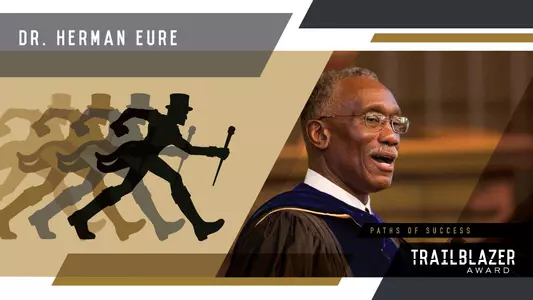
The distinguished faculty member and 2017 Wake Forest Medallion of Merit recipient played an integral role in building the university’s foundation.
When the Wake Forest Trailblazer Award committee gathered to review nominations for this year's honor, Dr. Herman Eure thought he knew exactly how the conversation should go.
After all, he was sitting right there with them.
"I'm on the Trailblazer Committee," Eure noted. "So, what happened was that we had a meeting and, of course, we looked over all the names that had been put forth. A lot of the names, of course, I had put on there, because I know a lot of people. I've been here a long time."
As he looked through the list of potential candidates, one name stuck out like a proverbial sore thumb to Dr. Eure — his own.
"You need to take my name off this list," he told the committee.
He believed his reasoning was sound.
"In my mind, it was to honor those folks who were in the athletic realm who deserved to be recognized because they had gone for so long in not being recognized," Eure said. "I felt I had been recognized for things, so I didn't feel like I needed to be included among that group of individuals."
Days passed before Eure's phone rang with a call from Wake Forest Associate Athletic Director Dwight Lewis.
"It was really a shock to me when Dwight called me and told me that I was selected," he said. "I thought, 'Well, how did that happen when we haven't had another meeting?' Then what I found out later on was that they had a clandestine meeting without me.
"I was surprised, humbled, and quite honored, because of the people who have been recognized as trailblazers in the past two iterations of the award. I am in awe of those folks, because they really came into a place that was sometimes quite hostile to Black student-athletes in particular, and they survived."
This year, Eure joins former Wake Forest women's athletics pioneer Roper Osborne Halverson as the two Trailblazer Award recipients — a pairing that resonates deeply with him.
"When I found out that Roper was also going to be honored at the same time as me, I was tickled to death," Eure said. "Because Roper is the reason that we have women's athletic programs at Wake Forest. Roper did everything. Everything."
While previous Trailblazer honorees broke barriers on the field, court, and track, Dr. Eure's legacy was built largely on the academic side of campus — through quiet mentorship, institutional change, and a relentless belief that student-athletes deserved both degrees and dignity.
"Now, I was there to help them, but I was in a different part of the campus," Eure explained. "My trailblazing had been on the other side, in academics and this kind of thing, other than the fact that I started to sort of court the student-athletes to get them into my classes and to get them into Wake Forest.
"That was one place where we could increase the minority student population."
The philosophy grew from lived experience. Raised in Corapeake, North Carolina — the seventh of 10 children — Dr. Eure came of age in a household where education was viewed as the most reliable path forward.
"My father told me all the time, 'The best way for Black men to get ahead is through education,'" Eure said.
He carried that advice to Maryland State College (now the University of Maryland Eastern Shore), where he arrived on what he believed would be an academic-athletic scholarship.
"I was a track person," he said. "Back then, recruiting was a little bit different. You didn't basically get what was a 'free' scholarship."
Instead, student-athletes worked daily jobs after classes.
"All of us — the basketball players, football players — had jobs after class," he said. "I worked every single day while I was there. Even when I did student teaching, I would come back, take off my tie and suit, and go to work."
That grind clarified his perspective long before he ever arrived at Wake Forest.
"I knew that predominantly white institutions were starting to see the benefit of Black student-athletes," Eure said. "But I also knew that many of the best athletes I had seen could have competed anywhere, but the doors were closed."
In 1969, Eure arrived at Wake Forest as the first Black graduate student on the Reynolda campus. He transitioned from student to faculty member — becoming the university's first Black full-time professor — and eventually found his calling not just as an academic, but as an advocate.
"My concern was academics," Eure said. "I knew how to talk to Black men in particular about what being an athlete should mean, because most of them were never going to earn a living from sports. Ever."
His work began with legendary men's basketball coach Carl Tacy.
"I told them I would be willing to help," Eure said. "I said, 'I will talk to them alone. I won't discuss athletics. I'll only talk academics and you need to promise me you will do everything you can to help these kids earn a degree.'"
His earliest recruiting efforts brought Alvis Rogers, Guy Morgan, Jim Johnstone and Mike Helms to campus. Soon, his influence expanded into women's athletics as well.
"I helped Wanda Briley recruit the first two Black women at Wake Forest — Keeva Jackson and Sonya Henderson. Then, my niece Janice Collins came, and later Hellen Williams," Eure said.
Inside the classroom, Eure operated by simple rules: no shortcuts, no favoritism — just effort.
"I told them, 'I am not going to give you a grade, but I will do everything I can to help you pass this class. If you put in the time, I will put in the time.'"
That promise defined his relationship with Wake Forest men's basketball legend Guy Morgan.
"Guy came to my office two or three times a week," Eure said. "Once people found he could play basketball, they stopped training his brain."
Eure promised Morgan's parents that he would do everything in his power to get their son through school.
"So, for me, he is one of the ones I'm most proud of," Eure said. "He earned that degree. Nobody gave it to him."
Wake Forest women's basketball guard Keeva Jackson-Breland remembers those same principles playing out through compassion.
"Dr. Eure was the leading force in my life at Wake Forest," she said. "He was like family. My mother met him and knew I'd always have a place to go. Sonya and I babysat his children. We just had a place to go, and Dr. Eure was always there for us.
"He was like a father figure to me. I had my own father, but I was away. He made Wake Forest feel comfortable."
Eure's mentorship also shaped conversations with future NBA players Randolph Childress and later Josh Howard.
"I told them, 'If you don't do the work, I'll give you the biggest F you've ever seen, because you would have earned it,'" Eure said.
When Josh Howard lost control during a game early in his career, Eure confronted him directly.
"I told him his behavior embarrassed me," Eure said. "That when you're a captain, your response doesn't just belong to you alone. It hurts the whole team if their best player is thrown out of the game!"
Years later, Howard would share the story publicly during graduation ceremonies — a moment Eure says confirmed the impact of that hard conversation. Eure's influence extended beyond the gym.
"At times, I invited students to my house," he said. "Not to talk about the sport, but to talk about life."
Tim Duncan and Tracy Connor were frequent visitors, but one of the relationships that meant the most to Eure involved former Wake Forest star forward Rodney Rogers — not during Rogers' NBA rise, but long after his playing days were over.
"I think one of the things I'm most proud of is helping Rodney finish his journey with Wake Forest," Eure said. "Every time Rodney came back to campus during the summers, he would talk to me about getting his degree. Every single time."
Rogers' playing career brought fame, financial success, and eventually devastating physical hardship, but the desire to complete what he had started at Wake Forest never wavered.
"Even after Rodney was injured and in a wheelchair, he came back and said, 'What can I do?'" Eure said. "So I went to the Dean of the College and asked what we could do to help him."
At first, the obstacles seemed overwhelming because Rogers still needed too many classes to finish online. But then the Dean suggested an honorary degree.
"With support from the Provost and the Dean of the College, we started putting together a plan," Eure said. "Because all Rodney wanted was a Wake Forest degree. That meant everything to him."
Eventually, that plan became a reality. Rogers was awarded an honorary graduate degree — a moment Eure describes as one of the proudest of his entire career.
"That was the university's values showing up," Eure said. "They knew what Rodney had meant to Wake Forest and what he has continued to mean to Wake Forest. They knew it was simply the right thing to do."
The story also reinforced what had always driven Eure's perspective on student-athlete support.
"I talked to the athletic department a couple of years ago, and my topic was, 'What is our commitment to these athletes beyond Wake Forest?'" he said. "Because our responsibility doesn't end when their eligibility ends. If somebody leaves this place without a degree and still wants one, we should be the ones reaching out saying, 'You've got X number of hours left — let's finish this.'"
For Eure, that mindset was never theoretical — it was rooted in lived experience.
"You can't convince me that athletes can't handle academics," he said. "There's no way you can be dumb and learn all the plays you have to learn in basketball or football. You can't learn that much and be dumb. It's impossible.
"I had the advantage because I was an athlete, and I earned a Ph.D. Nobody could tell me I was trying to ask these students to do something I hadn't already done myself."
Institutionally, Eure shaped programs that permanently connected athletics and academics.
"One reason we created the Office of Minority Affairs was to provide a home for students who didn't feel seen," he said.
Later, Eure helped establish both an athletic ombudsman position and the now-permanent academic counselor position within the athletic department.
"That counselor reported directly to the Dean," Eure said. "It connected two worlds that used to operate separately."
Eure never forgot his own early days on campus.
"When I first arrived, people assumed the only reason I could be here was athletics," he said. "One woman even asked if I fixed vending machines."
Yet inside the Biology Department, he found encouragement.
"They treated me like an equal from the beginning," Eure said. "They believed in me," he said. " At Maryland, Dr. Abram never doubted me. I graduated with honors, magna cum laude. I was deeply involved in student government, demonstrations, and the Governor's Council.
"I was involved in everything I could be involved in because I knew I wasn't going to waste the opportunity."
Growing up among 10 siblings reinforced that urgency.
"I was cutting wood in the snow thinking, 'This is not the life for me — I'm staying in school,'" Eure said.
Standing now as a Trailblazer Award recipient, Eure reframes the moment not as personal validation, but instead a communal acknowledgment.
"I think you do things because they're right," he said. "Not because you think you're going to be rewarded."

.jpg&height=340&type=webp)
Thursday, October 22
Tuesday, October 20
Wednesday, October 14
Tuesday, October 13