Wake Forest Athletics
12/16/2025 9:50:00 AM | General, Women's Basketball, Women's Golf, Women's Volleyball
The 2013 Wake Forest Sports Hall of Fame inductee helped set the foundation through her perseverance and competitive spirit as a multi-sport standout and Winston-Salem legend.
There is a moment that still catches Roper Osborne Halverson off guard.
She is back on campus, walking toward Reynolds Gymnasium or the Shah Center — the former a space that once barely acknowledged the existence of women's athletics and the latter not even existing itself — and she stops.
"I strut when I'm on campus," she said, laughing. "I do the Deacon Strut. When I came back for my 50th reunion, I kind of got lost behind Reynolda. I was like, 'what is all of this'?"
She takes it all in slowly now — the renovated facilities, the locker rooms, training spaces and the equal treatment that was once unimaginable. It is hard to reconcile with what she remembers from the early 1970s, when women's athletics at Wake Forest was little more than a developing idea housed inside the physical education department.
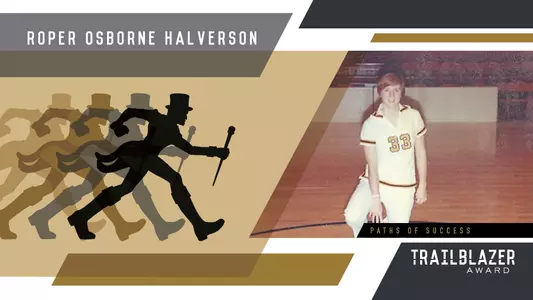
Yet Halverson is being honored for helping bring Wake Forest Women's Athletics into existence, as she is being honored as the latest recipient of the Robert Grant and Kenneth "Butch" Henry Trailblazer Award.
"I look at the folks that came before — Sonya (Henderson) and Keeva (Jackson-Breland) and all that they went through," Osborne Halverson said. "I've never thought of myself as a trailblazer. I used to think of myself as ahead of my time athletically."
That line — ahead of her time — has followed Osborne Halverson for much of her life. It explains the chip she carried as a child who watched her younger brother put on baseball and football uniforms she was told she could never wear.
"I had what my mom and dad called God-given athletic talent," she said. "I could go to all my brother's baseball and football practices. I think I did everything with him but wrestling. But I never understood why I was better than those guys out there but couldn't put the uniform on."
Those early moments shaped more than her competitive personality. They became the foundation of her willingness to challenge expectations simply by showing what she could do.
"To God be the glory for the talents that He's given me," she said. "It's my hope and prayer that I've used them as He's needed me to use them in my life."
That outlook would eventually lead her to Wake Forest — not with the intent of starring in multiple sports, but with a far more basic purpose.
"I didn't go to Wake to play basketball or volleyball," Osborne Halverson noted. "I went to start a women's golf team."
Building Something From Nothing
Osborne Halverson grew up in Winston-Salem and graduated from R.J. Reynolds High School. Her connection to golf ran deep. Her grandfather was friends with legendary Wake Forest golf coach Jesse Haddock, both members at Pine Brook Country Club. She spent afternoons on the range, learning the game and occasionally receiving impromptu swing lessons when Haddock happened to be around.
Wake Forest already owned one of the strongest men's golf traditions in the country, but when Osborne Halverson arrived in 1972, there was nothing comparable for women.
"I wondered why Wake didn't have a women's golf team," she said. "Not really paying attention to the fact that they didn't have much of anything else for women because Title IX had just kind of come into play."
Following her father's suggestion, she enrolled at Wake Forest ready to face the tremendous challenges that awaited her.
"We couldn't afford for me to live on campus," she said. "So, I decided, since Wake Forest didn't have a women's golf team, I was going to start a women's golf team. That's why I went to Wake Forest."
Once enrolled, Osborne Halverson made her intentions clear. Her physical education elective placed her under the supervision of Marge Crisp, the school's women's golf coach. She went directly to Crisp with a simple question.
"I asked Marge why there wasn't a women's golf team," Osborne Halverson recalled. "I said, 'I'd like us to start one.'"
Crisp's reply set the threshold: find five or six women, and she would try to secure tournaments.
"So, I went out and found five players," Halverson said. "I came back and told her, 'I have five players,' and the rest is history."
Wake Forest fielded a women's golf team for the first time. Unlike the men, who practiced at Old Town, the women traveled to Grandview once club members finished playing — often not gaining access until late in the afternoon. Without vehicles of their own, some simply couldn't attend.
"You couldn't walk there from campus," Osborne Halverson explained. "So if you didn't have cars, you couldn't get to the course. It was just a cluster."
But to Osborne Halverson, logistics were simply problems to solve rather than deterrents. And soon, her willingness to try anything athletic produced another opportunity entirely by accident.
Leaving golf practice one evening, she heard the sound of volleyballs echoing from Reynolds Gymnasium's lower court.
"I peeked in, and it was a bunch of people hitting volleyballs," she said. "Coach (Nora Lynn) Finch was at the door. She asked, 'Are you here for volleyball tryouts?' I said, 'no, I was just leaving golf practice.' She said, 'Have you ever played volleyball?' And I said, 'Yeah, in high school.' So, she told me to come in and hit the ball around."
She made the team that night.
Basketball followed soon after.
Suddenly, the student who had enrolled to build a golf program became a three-sport college athlete. Halverson decided to come to Wake Forest to start a women's golf program, but suddenly found herself playing basketball and volleyball as well. Plus she competed in both racquetball and badminton intramurals, where she became a four-time champion.
"I didn't even know what racquetball was," she said. "Coach Finch took me to a racquetball court and I got hooked."
Badminton proved more humbling.
"Dot Casey took me to the court," she said. "I thought badminton was what you play in the backyard. She buried that birdie down my throat and taught me that there's a different way to play."
A Championship Without Resources
Time management could have derailed everything. Practices didn't even begin until 7 p.m., after intramural programs cleared the gym floors. Academic work was fit into any open space — stairwells, empty rooms, or the gym itself.
"I'd hole up in the gym," Osborne Halverson said. "I never found the library a very happy place to study."
Despite the schedule strain and the lack of resources, the volleyball program hit a historic stride during the 1975 season.
The Deacons, on their third coach in four years and just the fifth season of the program's existence, surged to a 31–9 record, winning the state tournament under the Association for Intercollegiate Athletics for Women (AIAW) umbrella and sweeping the Memphis State regional to earn a bid to the first Small College National Volleyball Tournament in Pocatello, Idaho. That team still holds Wake Forest's single-season wins record and best winning percentage.
"We're still the only volleyball team that's gone to a national tournament here," Osborne Halverson noted.
Those accomplishments came without infrastructure most student-athletes now take for granted.
"We had one set of knee pads and one water bottle," she said. "And the kids today look at you and say, 'Did you drink from the same water bottle?' Yeah — we didn't know anything else."
Travel required personal vehicles. Equipment was minimal. Tournament entry fees were scrounged together through the physical education department.
Then came the biggest hurdle: affording the national tournament trip.
"When we won the bid, it was going to cost $10,000 to go," Osborne Halverson said. "So I called my dad. Kelly Jordan called her dad. All of a sudden, we had $10,000. We don't know where it came from. But we had the money to go."
Complicating the journey further, a United Airlines strike rerouted the team to five separate flights between Winston-Salem and Idaho. Coaches feared losing the large hard-shelled Samsonite luggage they usually used.
"They bought us little duffel bags just big enough for uniforms and shoes," Osborne Halverson said. "The bags did say 'Wake Forest' on them."
Against the odds, they arrived fully equipped.
"That would never happen today," Osborne Halverson smiled.
Competing against championship-level competition while trying to adjust to unfamiliar rule interpretations, the Demon Deacons battled but were ultimately defeated.
"We got hammered," Osborne Halverson acknowledged – although their accomplishments still litter the Wake Forest record book.
A Star on the Court
While volleyball provided the most dramatic team moment, Osborne Halverson's dominance extended into basketball — where she served as a captain and earned AIAW all-state honors.
As a junior, she averaged 15.8 points and 12.3 rebounds per game. As a senior, her scoring improved to 18.8 points along with 7.9 rebounds. She was named to the North Carolina Small College all-conference team and the Division II All-Division basketball team in 1976.
Her style reflected her trailblazing mindset — aggressive, instinctual and fearless.
She still laughs recalling a moment against UNC Greensboro.
"I got a rebound and saw one of my teammates wide open, but as soon as I put the ball on the floor, I wasn't stopping," she said with a chuckle. "By the time I got to the free-throw line, all five defenders were back. I still went straight through the middle to the basket, but was called for a charge."
As the bodies collectively peeled themselves off the floor, Osborne Halverson's first question was if her shot found the bottom of the net.
Pioneering More Than One Path
Upon graduation, Osborne Halverson stayed at Wake Forest — not by design, but by natural evolution. She served as an assistant coach for volleyball and basketball and became the university's first female athletic trainer in 1977.
Her training room was, literally, a closet.
"There was a women's bathroom outside the lower gym," she said. "You went into one stall, opened a door into a little closet where I taped ankles for five years."
Access to the men's training room came only when football staff were away — and eventually only after Osborne Halverson was granted a key.
Her presence on the sideline changed norms quietly — and she would go on to build a four-decade career in medicine, working as a nurse and leader throughout Forsyth County.
Growth and Loyalty
Osborne Halverson never left Wake Forest in a literal sense — living in Winston-Salem her entire life. Her children grew up around the programs she helped build. She did broadcast commentary for women's basketball games for 17 years and maintained deep relationships with players and coaches.
"There has always been a connection," she said.
And with teammates — especially that 1975 volleyball group — the bond remains unbroken.
"We had all but one come back for our 50th year anniversary a few months ago," she said. "Stephanie Glenn passed from breast cancer. Everybody else came."
Social media now keeps them connected more easily, but reunions have happened for decades — through weddings, baby showers, anniversaries, and Hall of Fame inductions.
"We figured out how to get and stay together."
Hall of Fame recognition followed: Winston-Salem/Forsyth County (1990), R.J. Reynolds (2012), Mount Tabor (2014), Wake Forest Sports (2013), and ACC Women's Basketball Legend honors (2012).
The Meaning of 'Trailblazer'
Only now, with the Trailblazer Award in hand, is Osborne Halverson beginning to accept the label she's long resisted.
"No — when I look back through that lens," she said, "I've done some firsts. Even in nursing. Even in golf at 13."
Earlier, she'd carried a chip from being barred from boys' sports. Later, the inequities of college athletics sharpened her sense of fairness.
"We had 75 cents for breakfast, $1.25 for lunch, $2.50 for dinner," she said. "Everything closed at nine. After a seven o'clock game, you hoped the gas station was open."
But regret never entered the equation.
"We didn't bemoan any of it," she said. "It took all of us laying that foundation for women's athletics to get where we are today."
She pauses.
"I think it's absolutely amazing."
And when Osborne Halverson steps onto campus now — into buildings shaped partly by the groundwork she laid — she does what she's always done.
She keeps moving forward.
She struts.

Thursday, October 22
Tuesday, October 20
Wednesday, October 14
Tuesday, October 13