Wake Forest Athletics
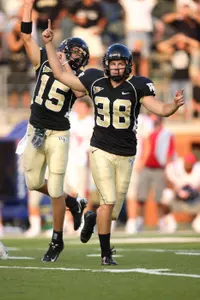
Fresh Deacs to Seasoned Vets: Wake's Senior Class Entered as Brash Youngsters But Leaves as Champions
12/8/2008 12:00:00 AM | Football
Dec. 8, 2008
In the fall of 2004, Wake Forest was either a basketball school or a field hockey school. Chris Paul was a freshman leader among boatloads of returning talent, and coach Jen Averill was on her way to guiding the Deacs to the hockey program's third straight national championship.
Take your pick. Either way, it was certainly not a football school.
One bowl trip over the course of the previous 11 seasons was not a tragedy; it was reality. Though improvement had taken shape beginning in 2001, when Jim Grobe arrived in Winston-Salem, the Demon Deacons still were limited to a middle of the road showing, with consistently mediocre 3-5 conference records during Grobe's first few years.
For fans of the old gold and black, it was a time when football was a bridge to the hardwood. Tailgating was a fun activity while watching the leaves change, but taking down Coach K at the Joel brought jubilation to a Nation of Tie-Dye. It went without saying that the 12-member basketball team would have more future pros than the football squad, with more than five times the roster.
My, how times have changed.
Although Wake Forest would continue to struggle record-wise through 2005, the seeds for success were undoubtedly planted by a confident class of freshman, a group that entered Wake Forest with a collective attitude uncharacteristic to these parts. They expected to play, compete and win. They planned a transformation of the program.
Seriously, who did these kids think they were?
"I kind of thought at first [that they came in with too much attitude]," says Eric King, the current Tennessee Titan who was a senior when the Fresh Deacs, as they were nicknamed by assistant Matt Wickert, arrived in Winston-Salem. "But over time I realized it was good because that was the kind of attitude I had when I was a freshman."
It was not that this class was ignorant of the football social structure, of which freshmen are typically at the bottom; quite simply, they refused to accept it. As a group, they bonded early, connecting thanks to a special brand of confidence that was uncommon for Wake Forest football.
"They brought us all together in the team meeting room," remembers NFL-destined linebacker Aaron Curry. "After the team meeting we went to the cafeteria together, just all the freshman class, we sat down together and we all made our minds up that we were going to make a change around here, that we'd somehow impact this program...We definitely were telling each other that we wanted to be something special. We didn't want to come out here and just play average. We wanted to be better than average. But the only way to do that is to come out every day and work hard. And we did that together."
"We all just got along," agrees Stanley Arnoux, the middle linebacker whose intelligence and quickness perfectly complements Curry's strength and enthusiasm. "The whole class was pretty tight through the whole redshirt year."
Waiting in the wings, the Fresh Deacs were eager to prove to the fans what every football upperclassman had already realized.
"I knew that they had the talent," recalls King, the sprightly cornerback who will welcome a bunch of former teammates as professional colleagues next season. "Coach Grobe even told me, `we could help you out by playing some of these younger guys,' but he wanted to keep them around for the future. So I totally understood him."
If you are in search of a case study as to just how successful the Grobian philosophy of redshirting has been, the experienced Fresh Deacs represent a fantastic example. The recruiting class of 2004, playing as third-year sophomores, vaulted the Demon Deacons onto the national radar in 2006, winning more games than ever before (11) en route to an ACC Championship.
Aside from veteran leaders like Steve Vallos, Josh Gattis and Jon Abbate, the matured redshirt sophomores helped provide a foundation for not only the unprecedented season, but also for the sustained position in the ACC hierarchy that Wake Forest remains a part of in 2008.
Say what you want about the few frustrating losses this fall, but the Deacons have remained in the football conversation from wire to wire, keeping the hearts of fans focused on tiebreakers and bowl scenarios instead of a top-five recruiting class at the Joel Coliseum. Although Wake Forest basketball is in position for one of the best seasons in school history, their local preseason hype has, for the most part, slipped below the radar.
The campus notoriety typically reserved for the likes of L.D. Williams, Jeff Teague and Al-Farouq Aminu has been discovered and embraced by Aaron Curry, Alphonso Smith, and D.J. Boldin, three of the fifth-years who have gained national acclaim during their final season. With help from teammates past and present, a culture shift has been created, with the entire senior class at the epicenter of the tectonic tilt.
All together, the Fresh Deacs are composed of 13 remaining players, not including sixth-year grad student Matt Robinson, each of whom has left an indelible impact on the program and the memories of grateful fans.
"It's gone by fast," says Smith. "Last year as a junior I wasn't thinking about it as much as this year. Now that I am a senior, I am kind of trying to slow down the season. It seemed like yesterday I was a redshirt freshman."
Fullback Rich Belton echoes a similar sentiment as he nears the end of a turbulent career. His 33-yard scamper score against Florida State two years ago in Tallahassee remains a trademark play of the 2006 season, right up there with his goal-line surge into the end zone on a fourth-down carry in College Park that clinched the Atlantic Division crown over Maryland. Despite missing much of the 2007 campaign due to injury, his place in Wake Forest lore, like his peers, is secure.
"A lot of guys were talking in the locker room just saying it's been a long road," says Belton. "We remember back to our freshman year when we were just moving into our dorms and now it is our last home game. It just seems like time flew by since we got through our redshirt year."
It only takes a few minutes of conversing with any fifth-year senior to realize how special the Fresh Deac bond has been. From that first meal in the pit to their final regular season game at BB&T Field, they have grown into a band of brothers, tighter than they would have ever imagined.
When asked what he would miss the most about Wake Forest football, cornerback-turned-safety Kevin Patterson responded, "Probably the camaraderie between the team and the friendships that I've gained here. The seniors were so close; it's a bond that will never be broken."
Likewise, the transformation that Demon Deacon football has encountered during the primes of its best-ever senior class will never cease to exist. Some will move on to the NFL and continue to make Wake Forest proud; others will simply cap their college football careers with a diploma and an unparalleled amount of pride.
Stanley Arnoux, Rich Belton, D.J. Boldin, Chip Brinkman, Aaron Curry, Anthony Davis, Kerry Major, Chantz McClinic, Kevin Patterson, Alphonso Smith, Sam Swank, Chip Vaughn, and Antonio Wilson will leave behind an unforgettable legacy of euphoric moments and transcendent success.
And now, largely thanks to the Fresh Deacs, Wake Forest is also a football school.