Wake Forest Athletics
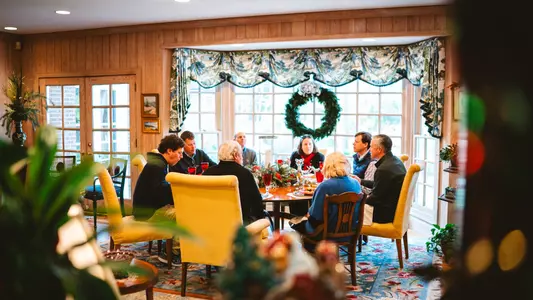
Around the Dining Room Table
12/9/2025 9:47:00 AM | General
There's only one rule that Linda Ball Tucker (P '95, P '97, P '04, GP '28) has around her dining room table: no talking business. Any other topic is fair game – the dissection of a recent Demon Deacon basketball game, news about her eight grandchildren, health updates from the latest doctor's appointment or stories from the boys' last golf outing. For an hour in the middle of a day each week, while they enjoy home cooking and each other's company, Linda and the five Tucker men get a reprieve from their work at the family lumber company.
For 105 years, generations of the Tucker family have been stalwart members of the Pageland, South Carolina, community. When the town boasted just 520 residents, Carl Tucker Sr. started the C.M. Tucker Lumber Company, LLC, and four generations later, the company still sits near the crossroads of the small town.
"My grandfather began this business in 1920. At that time, most every little town was self-sufficient, especially in the Southeast where trees were available for a lumber operation," said Carl Tucker III ('68, P '95, P '97, P '04, GP '28). "We were in the retail business and the manufacturing that supported it. We even made windows and doors."
The founding Tucker believed that durable, well-made products, personal contact and exceptional service were the elements of a successful business. He passed that philosophy for high quality offerings and close community down to his son, Carl Tucker Jr., who joined the company in 1935.
Then, on the day after the attack on Pearl Harbor, Carl Jr. left the family business. According to his draft card, he was 27 years old when he volunteered for the Navy. When he returned from World War II, Carl Jr. went back to supplying his neighbors with lumber and delved into specialty products to help make the company more distinctive. He also invested heavily in other aspects of the community, including teaching a men's Sunday school class for 44 years and serving for 35 years with the South Carolina Mental Health Commission.
In 1964, four decades after his grandfather founded their South Carolina lumber company, Carl Tucker III crossed the state border to begin his education at Wake Forest. Among the magnolias, he studied economics, joined a fraternity and learned the ins and outs of being a Demon Deacon fan. He watched Brian Piccolo ('65) in his senior campaign and witnessed the transformational Bill Tate years. He also found himself excelling in the classroom, consequently serving as a peer tutor for student-athletes. And many of the friendships he made more than 60 years ago are still strong.
When he graduated in 1968, Carl didn't go back to the family business immediately. He pursued a degree in graduate education at Ohio State and then returned to the classroom in a new role.
"I thought that I wanted to teach economics," he shared. "I decided after a year of teaching that it wasn't for me, and it wasn't for generations of students!"
By the time Carl started working for the lumber company in 1970, the retail industry had changed. Mom and pop stores were being replaced by large retailers. In order to compete, Tucker Lumber had to innovate.
"We learned to think like the big companies did and learned to anticipate what they wanted," said Carl. "We did an excellent job of that, and it spurred our growth."
The changing times meant that Carl worked to update the equipment throughout the mill. He also added new dimensions to the business – exploring wood preservation and adding lumber remanufacturing machines in order to produce specialized products.
While Carl ran the business, his wife Linda, whom he met while working in Acadia National Park during a summer in college, worked as a home economics teacher in Pageland. Together, they raised four sons – David ('95, P '28), Mark ('97), Paul and Andrew ('04).

"They had all grown up in this small town, gone to public high school and began to decide what they wanted to do," said Carl.
Three of them followed their father to Wake Forest and majored in business. Then, they had to decide ("With no pressure," said Carl) if they wanted to join the family business.
"Mark and I grew up working in the plant," explained David. "We started out at the lowest level – tagging lumber. As we got older, we could be around bigger machines, and we started running those."
When David was a junior, he did an internship at Tucker Lumber. Instead of working in the plant, he wanted to explore the intricacies of life in the office.
"I came back that summer, and I sat and listened," said David. "It was a great experience."
Mark, on the other hand, knew he did not want to be in the office and gravitated toward the operations side of the business. "I didn't want to wear a tie to work," he joked.
The day after he graduated in 1997, Mark headed to the company's plant in Middleburg, North Carolina. A manager left, and Mark was called upon to help handle the situation. "Trial by fire," he remembers. "I was making decisions and doing things from an operational standpoint that anywhere else would have taken me years to experience. You win some, you lose some, but the ones you lose, you learn from."
While David and Mark joined the business immediately after graduating, Paul and Andrew tried other paths before returning to Tucker Lumber and joining their father and brothers.
As part of the fourth generation of Tucker leadership, each son is passionate about the company in his own way. David is charged with the administrative elements of the company; Mark handles the operations; Paul lends his talents to client relations; and Andrew helps manage relationships and takes care of the purchasing.
"We all have our strengths and weaknesses," said Paul, who attended Duke University on a golf scholarship. "We all realize our own and realize each other's. Where I'm weak, one of my brothers covers that weakness; where I'm strong, that's where I fit. We have done a good job over the years working together to have a powerful group of five manage the company."
"We all sit around the table and talk about things and share ideas," said David.
In leading their family business, the Tuckers move forward with decisions only when every member is in complete agreement.
"It must be a 5-0 decision," said Carl. "If there isn't agreement, the topic is tabled."
"Having all of us in agreement helps the harmony and has gotten us where we are today," said David.
Some of those unanimous decisions have led to great advancement for the company, which has seen its fair share of development and evolution over the years. Creativity, efficiency and technology have made it possible for it to move from a neighborhood lumber yard to one of the highest-volume lumber pressure treaters in the country.
On the sprawling grounds of Tucker Lumber, the original saw mill is still there, making fence rails and posts. It's a small operation with the traditional kind of milling taking place.
The manufacturing component of the company is highly productive. More than 500 products are made onsite – from porch railings to fences and mailbox posts. The introduction of new technology and robotics has allowed for quicker production and more accurate work. Six pieces of machinery were custom made for their operation.
Many of their lumber supplies are sold in Lowe's Home Improvement stores – another local business founded in North Wilkesboro, North Carolina – including those along the I-77 and I-95 corridors. Each day, hundreds of trucks ship Tucker Lumber products as far north as Massachusetts, as far south as Florida and as far west as Texas.
The company has also grown its wood preservation division. Tucker Lumber is known as one of the foremost experts in chemically treating wood. In fact, other mills around the country send their lumber there to get it treated. This high-tech operation runs 24 hours a day, seven days a week.
The family is also strongly committed to environmental stewardship. Known as "tree farmers," the Tuckers plant more than 300,000 trees a year. They also make sure that no part of the tree is wasted in their processes. That means that their byproducts are made into receipt paper and cardboard. Newsprint was once produced from Tucker Lumber byproducts, but now Amazon boxes are the dominant product. And other waste is collected and used in the poultry industry.
Tucker Lumber is one of the largest employers in Pageland, South Carolina. They have 450 employees at facilities in three locations – Pageland, Rock Hill, South Carolina, and Middleburg, North Carolina.
Like many companies, the business has weathered the ups and downs of the economy and market demands. They remember tougher times – like having to borrow high interest rate loans and navigating COVID – but nothing has compared to what they have endured as a family.
More than a decade ago, Carl was diagnosed with chronic lymphocytic leukemia.
"It's not curable, but it's manageable," said Carl.
As a result of his compromised immune system, he contends with a second cancer – squamous cell carcinoma – that has required him to undergo 68 surgeries to remove metastasized cancer on his arms, legs and face. He goes to the doctor once a month to try to balance his treatment plan and keep tabs on his overall health.
Recently, the Tuckers sold the family business to a company willing to keep and nurture the culture that Carl Tucker Sr. created a century ago.
"We take pride in being involved in folks' lives here," said Andrew. "We know when it's their kids' birthdays. We've been through a lot with the folks here and plan to continue. The family atmosphere is why I'm still here."
Though ownership is gone, the Tuckers continue to operate the newly formed Doman Tucker Lumber. And, the fifth generation – Mark's son, Davis – got some work experience there over the summer before heading to college.
The Tucker Family– who taught their sons the Wake Forest fight song early on – have been faithful supporters of Wake Forest. They give where there is the greatest need: anything from current-use funds to scholarships to capital projects. In January 2025, Wake Forest dedicated the Tucker Family Student-Athlete Excellence Center to assist Demon Deacon athletes in the classroom – just as Carl had nearly six decades ago.
The most recent gift made by Carl, Linda and the families of his three Wake Forest alumni sons will name three current-use football scholarships and name the Tucker Family Assistant Basketball Coach position currently held by BJ Mackie.
Their investment will split equally between newly created current-use scholarships and sport-restricted excellence funds, which will directly enhance the operating budgets of various athletics programs. With recent changes to roster limits, the creation of additional scholarship opportunities will allow Wake Forest to expand access to deserving student-athletes while also sustaining resources needed for competitive excellence.
Long ago, the Tucker family found a home and invested in it – the people, the place and the potential. When it came to serving their community, they did so without hesitation. As the family grew, so did its generosity and its definition of community.
This commitment to each other and generosity to their community was reinforced around Linda's dining room table – where faith and family were served over delicious food and fellowship.

.jpg&height=340&type=webp)